
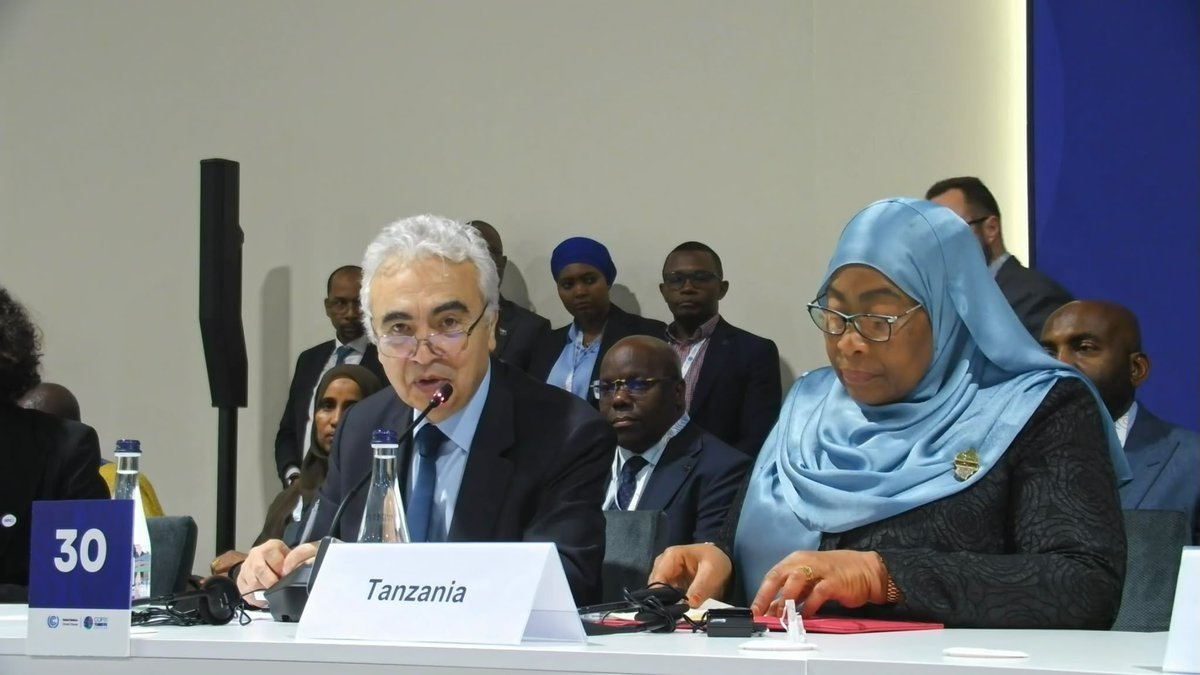
- Climate change costs Tanzania 3% of its GDP annually.
- President Samia calls for more clean energy subsidies.
- Tanzania phasing out charcoal from public institutions.
Climate change shocks cost Tanzania up to 3% of its GDP annually, President Samia Suluhu Hassan told the 31st United Nations Climate Change Conference (COP31) in Antalya, Türkiye. During this year’s World Leaders’ Summit, President Samia called on global leaders to move from making climate pledges to delivering on them.
In this regard, President Samia highlighted the $2.2 billion pledged at the 2024 Paris Summit noting that while $740 million had been deployed across 22 African nations and $900 million in new pledges were mobilized; “leaders must measure success by actual household adoption rather than pledges alone,” she insisted.
President Samia stressed that adaptation targets must follow the principle of “common but differentiated responsibilities,” recognizing the distinct development needs of vulnerable economies.
In her address to a high-level side meeting that focused on clean cooking energy, the president called for fair, transparent carbon pricing as well as increased access to climate finance.
She pointed out that Tanzania is making considerable progress and 35% of the country will be using clean cooking solutions by the end of this year and at least 80% by 2034.
The High-Level Roundtable on Clean Cooking in Africa reviewed the need to increase access to clean energy household equipment for Africans as well as subsidies for the same.
Among the clean energy household equipment considered for subsidies included LPG Cylinder Distribution.
As an example, President Samia said her government facilitated the rollout of over 346,000 subsidized liquefied petroleum gas (LPG) cylinders to lower income families.
Another is Electric Cooking (eCooking), she said Tanzania had distributed more than 49,000 induction stoves and 7,000 electric cookers by March of this year.
“The government reduced electricity tariffs for cooking services, expanded rural electrification, and applied tax exemptions on clean cooking equipment to make them affordable,” she revealed.
President Samia said Tanzania is actively phasing out firewood and charcoal from all public institutions that serve more than 100 people.
She further cited the country’s Energy Transition and Investment Plan which she said covers partnership between the country and the World Bank and the African Development Bank to scale clean cooking infrastructure across schools and healthcare facilities.
She went on to also cite the CookFund Programme that Tanzania is implementing with support of development partners.
According to President Samia, the programme has equipped over 413,000 households and reached nearly two million people.
The programme has also supported hundreds of local clean-cooking businesses, and transitioned some 45 public institutions that serve more than 62,000 students.
“The program has helped to cut the emission of an estimated 3.8 million tonnes of carbon dioxide,” she said.
Summing up, President Samia presented a dual climate agenda centered on its $37 billion National Adaptation Plan (2025–2035) and an expanded carbon trading framework backed by Sh6.6 billion in new domestic funding.
Also Read: Who will own the infrastructure powering Africa’s Artificial Intelligence revolution?
Tanzania national climate adaptation policies
Tanzania aligned its COP31 position with its Tanzania Development Vision 2050 and insisted that global leaders replace unfulfilled pledges with grants and concessional finance.
In it’s National Adaptation Plan (NAP 2025–2035) that was submitted ahead of the summit, Tanzania allocated $37 billion across 36 priority programs.
The programs cover key focus areas including agriculture, climate-resilient infrastructure, and upgraded water and sanitation services.
The country articulated four core priorities; climate resilience, accessible climate finance, institutional capacity and technology transfer, and addressing climate-related loss and damage.
To counter drought induced power disruptions and GDP losses of 2% to 3% annually, Tanzania highlighted its National Energy Compact, a policy declaration that looks to raise electricity connectivity to 75% by 2030.
Generally, Tanzania used COP31 to position itself as a regulated, transparent hub for international carbon markets under Article 6 of the Paris Agreement.
The government announced that it has invested in strengthening technical expertise in measuring, reporting, and verifying emissions and in upgrading its national project registration system.
Further still, under the Environmental Management (Amendment) Act of 2025 and updated Carbon Trading Regulations, the government of Tanzania formalized its National Carbon Monitoring Centre (NCMC) as the primary authority overseeing project registration and compliance.
Tanzania also announced more than 100 registered carbon projects covering forestry, renewable energy, agriculture, waste management, and transport.
Tanzania also emphasized strict regulatory rules that guarantee transparent carbon pricing, protect environmental integrity, and channel revenues directly to rural communities and local conservation.

Leave a Reply