


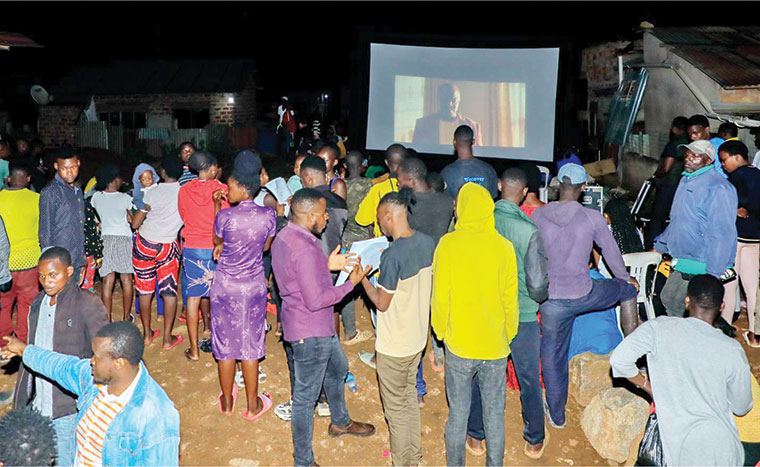
At just 3pm, a local cinema hall locally known as kibanda in the slums of Mutundwe is packed to the brim with youths enjoying an Asian action movie.
Seated on high-raised wooden benches with an earth floor, some of the youths are drinking waragi, others are munching on khat (mairungi) which is sold by a woman at the entrance, while others are eating kikomando (a mixture of chapati and beans). The action movie session is, however, interrupted by the team from Reach A Hand Uganda (RAHU), who put on Kyaddala, a Ugandan series.
Not understanding what is going on, a few of the youth get out but majority remain seated as they delve into the production, whose first season explores the daily life of a high school student within an African context, highlighting the interactions with parents, teachers and the broader community.
The series highlights the challenges these students encounter such as drug and substance abuse, HIV/Aids, teenage pregnancy, sexual harassment and the influence of their peers. Season two confronts the harsh realities faced by young people in African communities every day.
It highlights the oppression of African girls, who often have little say in their own life decisions, from their homes and marriages to reproductive health. The season addresses critical issues such as HIV/ Aids, disability discrimination, sexual harassment, gender-based violence, early marriages, drug and substance abuse and mental health.
However, the movie, which is mostly in English, not being translated into a local language like Luganda, made some of the audience members not happy as they could hardly grasp the English. In another cinema hall in Sankara zone in Kansanga, another group of young people gathered at Mukisa Cinemax to watch another Ugandan movie, Sabotage.

The youth and children sat steadily, watched keenly and listened attentively as this local drama which is about a career-driven woman who finds love and is excited about her dream traditional wedding until she finds out she is carrying her father-in-law’s child.
The film centres around the themes of culture and traditional values and how these intersect with the sexual and reproductive health rights of women in Uganda. The movie being translated by VJ Junior helped the audience to easily grasp the themes being addressed and from time to time, some members in the audience could be heard giving extra commentary.
The other film being screened is When You Become Me, which is about Africa, a writer with a speech impairment who is moved by the struggles of Liam, a visually impaired accountant facing workplace discrimination. Inspired by Liam’s situation and motivated by her father, Africa finds the courage to confront societal bias.
The films, which are selected for their ability to educate, entertain, foster dialogue and support behavioural change, are usually screened in densely populated areas around Kampala in ghettos of areas such as Kansanga, Ggaba, Mutundwe, Nalukolongo, Wandegeya, Kitalanga, Kitintale, Kazo, Lusaze, Kalerwe, Namasuba, Kyambogo, Bweyogerere, Mpererwe and Kanyanya, among others.
Taking such informative and educative movies to the local communities especially the ghetto areas is an innovative community outreach program spearheaded by Reach a Hand Uganda in partnership with Sauti Media Hub. Dubbed Kwiso Mu Cinema, the initiative involves the screening of selected Ugandan films that address pressing social issues such as gender-based violence and sexual reproductive health and rights.

These films are carefully curated to resonate with the local audience, using relatable narratives to illuminate complex topics. Following each screening, participants engage in facilitated discussions and debates where they can reflect on the lessons learned from the film and explore practical ways to implement these lessons in their daily lives and communities.
They express their thoughts about the films, share personal experiences and discuss the key messages of the film. Shafic Lubega, a resident of Kibaati in Sankara zone, having watched Sabotage, said he had learnt that girls should not be desperate and should not trust every advice they get from their friends since some advice can be misleading.
“For example, the girl who was advised by her friend to go for abortion from a traditional healer where she got complications which led to her death.”
Reagan Yuriya, 21, who also enjoyed Sabotage, advised girls to always be careful while dealing with their bosses at work because some of them might have ulterior motives and that basing on the film, it is better to quit the job rather than risk integrity and lives.
For Shafick Sekajja, who watched Kyaddala at Wandegeya, his key takeaway from the film was to know his rights as a youth and advised his fellow youth, especially those in the creative industry, to know the laws which can protect their craft so that it is not stolen by opportunists.
jjingoernest1@gmail.com
Source: The Observer
Share this content: