


On 14 February 1990, the Voyager 1 space probe took a now famous photograph of earth, from a distance of about 6 billion kilometers – which depicted earth as a very small, barely visible dot, when ranged against the expanse of the universe.
In his 1994 book, ‘Pale Blue Dot’, the astronomer Carl Sagan provided a powerful commentary on the photograph, observing: ‘Consider again that dot. That’s here. That’s home. That’s us. On it everyone you love, everyone you know, everyone you ever heard of, every human being who ever was, lived out their lives.
The aggregate of our joy and suffering, thousands of confident religions, ideologies, and economic doctrines, every hunter and forager, every hero and coward, every creator and destroyer of civilization, every king and peasant … every corrupt politician, every “superstar,” every “supreme leader,” every saint and sinner in the history of our species lived there – on a mote of dust suspended in a sunbeam.
The Earth is a very small stage in a vast cosmic arena … There is perhaps no better demonstration of the folly of human conceits than this distant image of our tiny world. To me, it underscores our responsibility to deal more kindly with one another, and to preserve and cherish the pale blue dot, the only home we’ve ever known.’
As Sagan notes, the power of the picture is in terms of the perspective it provides –the triumphs, hopes, dreams, big things and monumental events that have taken place on this earth over millennia – have occurred in a place which, while apparently expansive, is in the larger scheme of things, a little, barely visible part of the much larger cosmos that the known world is.
In this small part of earth, in Uganda, we are still struggling to find a meaningful and peaceful means of coexistence. We do not intend today to belabour the historical points made in previous editions of this column as to the problematic nature of the contemporary Ugandan State.
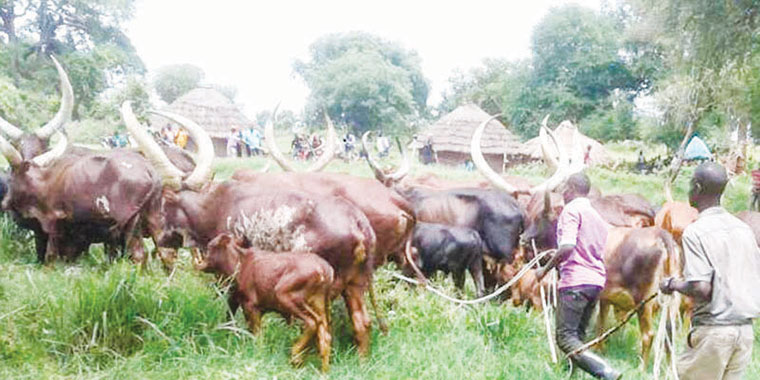
We need only to point out that we live, and will continue to live, with the fundamental contradictions of that State, unless and until we summon the courage and creativity required to deal with the sins that attended that founding. The ‘Balaalo’ issue – pitting pastoralist Bahima against parts of the population in Northern Uganda – is only but the most recent manifestation of the internal contradictions embedded within the myth of Uganda.
It makes me realize – with a combination of amusement and some sadness – that, like many of my generation in this country, I have become a young old man, or rather an old young man. We have grown in the age of Museveni, had children in the age of Museveni, and are now threated with becoming grandparents in the age of Museveni.
And, in the age of Museveni, the sins of Uganda’s founding have proven to be apparently intractable. Of course, there is nothing amusing about the Balaalo issue. It touches on serious questions regarding land ownership, power and vulnerability, identity and belonging, human rights – and dignity.
I just cannot help but recall a similarly heated discourse that occurred in the early 2000s, when my cohort and I were fresh-faced first year law students, full of hope and animated by the sense of endless possibility. In Prof Oloka Onyango’s first year constitutional law class, we were presented with the issue of the ‘Bafuruki’ – Bakiga immigrants in the Bunyoro area, who were beginning to attract resentment and hostility from the local population.
That particular crisis had been triggered by the electoral success of a one Fred Ruremera, a Mukiga who had won the Kibaale LC V Chair. His victory woke the Banyoro up to what they considered to be an existential threat: being overwhelmed – numerically, economically and otherwise by the Bakiga immigrants – with the eventual possibility of becoming landless and dispossessed in their own ancestral area.
The debate in our constitutional law class was passionate – arguments all round being presented. I recall a Munyoro classmate expressing particularly strong views against the Bakiga immigrants – so much so that I wondered whether her apparent resentment did not extend to myself and other persons of Kiga ethnicity in the class (my late father was a Mukiga, while my mother is a Munyankore). With the benefit of hindsight, I understand her frustration, her fear – and even resentment.
The issue then – as it is at the core of the current ‘Balaalo’ question – is a small provision tucked away in Article 29 of the 1995 Constitution. In terms of Article 29 (2) (a), every Uganda has the right ‘to move freely throughout Uganda and to reside and settle in any part of Uganda’.
The provision is as plain as day – the right is to ‘every Ugandan’, the freedom is to move unimpeded ‘throughout Uganda’, and the right to reside and settle relates to ‘any part of Uganda’. It does not say – ‘every Ugandan except Bakiga and Bahima pastoralists’, nor does it say ‘any part of Uganda except Bunyoro and Northern Uganda’.
And yet, of course, the reality is that Article 29 (2) (a), like many other parts of the 1995 Constitution, is based on a fundamental presumption – that the politico-legal entity known as Uganda is founded on, and supported by, socio-cultural reality or ‘facts on the ground’.
The provision, and the entire Constitution, rests of the myth of Uganda – the idea of ‘One Uganda, One People (to borrow from Dr. Kizza Besigye’s FDC slogan). The truth of the matter is that Uganda was and is composed of disparate societies, with unique histories – and distinct social, political and economic identities.
This diversity is not necessarily – or intrinsically – dangerous, but it is one which has to be carefully, sensitively and respectfully managed, if law and reality are to be brought closer together (as they should). In the Bafuruki crisis, for instance, as a short-term measure, President Museveni found a way of convincing Mr. Ruremera to stand down as Kibaale LC V Chairperson, which happened in 2002.
This was probably for the best – all considered. In the current Balaalo crisis, the President has called for the pastoralists to leave the affected areas. This, too, is probably for the best. In both instances, the strength of local feeling against the ‘aliens’ is too strong for any reasonable political system to ignore. At the same time, these short-term measures can only be that: short-term.
They are only bandages on what are festering wounds – deep cleavages within the Ugandan political and social fabric, which require equally deep, longer term and better considered responses.
Those in Buganda, for instance, are starting to ask – and rightly so: ‘If land in Northern Uganda can be protected from encroachment by “aliens”, why is it that land in Buganda is open to purchase by non-Baganda’? The historical answer can be located in an old case – Mwenge v Migadde (1932- 5) ULR 97 – in which a colonial court found that under the new land regime established under statutory law, land in Buganda could be sold in ways, and to persons, not contemplated or permitted under Buganda customary law.
The Kingdom of Buganda might thus, legitimately, assert a mandate to recover for Baganda – sovereignty over land in Buganda – on an equal basis with the emerging settlement of the Balaalo question. In the alternative, Buganda might rightly assert, based on this contemporary status as the one apparently open home for all Ugandans (regardless of ethnicity), greater consideration and a more significant role in determining the destiny of the Ugandan polity.
Whichever way one looks at it, the current ‘Balaalo’ question is only a window into much broader questions of equity, belonging, identity, citizenship, self-determination and others. It exposes the myth of ‘Uganda’.
This myth is at the heart of the vulnerability of Uganda’s current constitutional arrangements, and the political framework which both created the 1995 Constitution; and which in turn is legalized and legitimized by that constitution. By the same token, it demonstrates the futility of a patchwork or half-hearted approach to constitutional or politico-legal reform.
Now, more than ever, the Ugandan project needs to be rethought – and the courage found to consider effective means for adequately reflecting and accounting for the complexities posed by ethnic diversity. This is the essence of the ‘(Re) Constituting Uganda’ Project of the Human Rights and Peace Centre (HURIPEC) of the School of Law, Makerere University.
More than a project, it is an agenda for research, popular-engagement and constitution- making – one which recognizes that the duty to reconsider a new design for the Ugandan State and its constituent charter is a shared duty, not one to be left to politicians, who might lack
the will to undertake this task.
I am deeply heartened that this can be done at HURIPEC, and look forward to the launch of this effort at the School of Law this Friday, 1st December, from 11am to 2pm. Perhaps not entirely coincidentally, we shall use the same occasion to both commemorate, as much as reflect upon, HURIPEC’s own 30-year journey as an actor in the movement for human rights, peace and social justice in Uganda.
As Uganda experiences a national crisis of identity – this same moment can and must be seized as an opportunity to do the work necessary to extirpate the signs of its founding. I am personally grateful that the Chief Guest at the launch of the (Re)Constituting Uganda effort this Friday will be Nicholas Opiyo – who has both seen, and fought against the worst of the mythical Ugandan project and yet still has the energy required to believe in, and struggle towards, a Uganda that works for all, not some.
In the immortal words of Rev Dr Martin Luther King, Jr, ‘we must learn to live together as brothers or perish together as fools’ – in this very small part of a very small, pale blue dot.
The writer is senior lecturer and acting director of the Human Rights and Peace Centre (HURIPEC) at the School of Law, Makerere University, where he teaches Constitutional Law and Legal Philosophy
Source: The Observer
Share this content: