
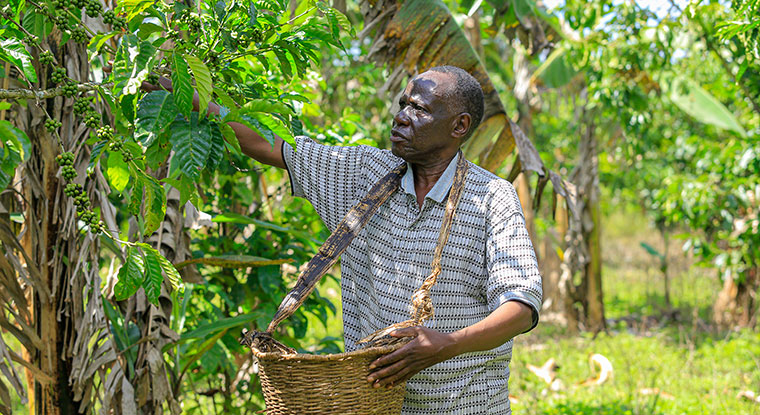
The katikkiro of Buganda, Charles Peter Mayiga, has urged the government to reconsider its decision to fold the Uganda Coffee Development Authority (UCDA) into the ministry of Agriculture, Animal Industry and Fisheries (MAAIF).
The proposed change, outlined in the National Coffee (Amendment) Bill, 2024, was introduced in March by Agriculture minister Frank Tumwebaze as part of the government’s broader plan to streamline operations, cut costs, and improve service delivery across government agencies.
The bill seeks to bring UCDA’s functions under MAAIF, aiming to eliminate overlapping mandates and improve efficiency within the sector. According to the government, the cost of managing numerous autonomous agencies has strained Uganda’s national treasury, diverting resources from critical service areas.
The bill, which is under review by parliament’s committee on Agriculture, Animal Industry and Fisheries, is part of the Rationalisation of Government Agencies and Public Expenditure (RAPEX) policy adopted by the Cabinet in February 2021. RAPEX seeks to merge or abolish certain agencies to reduce government spending and address issues of administrative redundancy.
In an exclusive interview with The Observer, the katikkiro underscored the close and productive relationship between Buganda Kingdom and UCDA, particularly through their shared goal of expanding Uganda’s coffee export to 20 million bags annually. Mayiga noted that UCDA’s role has been pivotal in supporting coffee farmers across Buganda, highlighting a memorandum of understanding under which UCDA provided 10 million coffee seedlings to the kingdom for distribution to local farmers.
This partnership, he explained, has enabled UCDA’s extension workers to reach remote areas, assisting farmers directly in improving crop quality and yield.
“UCDA gave us 10 million seedlings, which we distributed to farmers across Buganda,” said Mayiga. “The memorandum of understanding brought them closer to us, and the extension workers could easily connect with farmers in villages.”
He also highlighted the kingdom’s ‘Emwanyi Terimba’ campaign, through which UCDA staff participate in village visits to educate farmers on quality standards both in the field and post-harvest. This campaign, he added, has relied heavily on UCDA’s technical support, which is passed along to Buganda’s own extension workers in each county.
The kingdom’s coffee extension staff have received training from UCDA to spread these practices, extending technical expertise throughout Buganda and other parts of Uganda. Mayiga’s remarks add to ongoing debate over the future structure of Uganda’s coffee sector, with Buganda’s leadership and other stakeholders advocating to retain UCDA’s independence due to its direct role in supporting local farming communities.
As the National Coffee (Amendment) Bill advances through legislative scrutiny, these discussions underscore differing views on how to best support the country’s crucial coffee industry and expand its global market reach.
UCDA IMPACT IN BUGANDA
Reflecting on the initial challenges, Mayiga explained that when Buganda first engaged with UCDA, two primary issues emerged: field quality and post-harvest standards.
“Initially, it was difficult for UCDA to disseminate critical information on quality standards effectively,” Mayiga noted. “Through our collaboration, UCDA provided valuable information that was passed directly to farmers. When UCDA extension workers accompany us on outreach, farmers listen attentively, and the quality of coffee has substantially improved.”
Mayiga emphasized that quality management begins with the planting of seedlings and continues through post-harvest processes. Previously, farmers would often dry coffee beans on the ground, exposed to domestic animals, which impacted quality. Working alongside UCDA has helped to change these practices, with Buganda farmers adopting better methods that have resulted in higher-quality yields.
While the government’s Operation Wealth Creation (OWC) program also distributes seedlings, Mayiga argued that UCDA’s direct partnership with the kingdom has yielded better results.
“When we distribute seedlings in partnership with UCDA, they are quickly taken up by farmers, who trust our initiatives. However, seedlings distributed solely through OWC often sit unused at gombolola headquarters and dry up,” he observed.
The katikkiro pointed to the increasing number of people planting coffee as evidence of the effectiveness of the collaboration. Buganda now accounts for over 50 per cent of Uganda’s coffee exports, with estimates suggesting that more than one million households in Buganda and an additional 800,000 in other regions are actively involved in coffee farming.
On the government’s proposed rationalization of UCDA, Mayiga expressed cautious support for streamlining public agencies, noting widespread inefficiencies.
“There is excessive wastage of public funds in parliament, the size of the cabinet, the numerous presidential advisers, RDCs, and districts. Rationalizing parastatals is, in itself, a good move if it extends to these areas,” he said.
However, he urged that UCDA be retained as an exception, emphasizing the vital role of coffee in Uganda’s economy and the livelihoods of millions.
“Two million households across Uganda depend on coffee,” Mayiga pointed out. “This represents over 10 million citizens involved in the industry, making coffee unique in its impact. No other economic activity in the country engages as many citizens, which alone should be reason enough to retain UCDA.”
He added, “Phasing out an agency that sustains millions of livelihoods doesn’t make sense. Instead, UCDA should receive better funding, more resources, and greater priority. That’s simply logical.”
MWANYI TERIMBA CAMPAIGN
The Mwanyi Terimba campaign, launched by Buganda kingdom, began as an initiative to revitalize coffee farming, provide oversight to existing farmers, and reintroduce cooperatives with the goal of adding value to Uganda’s coffee exports. The campaign initially focused on mobilizing people across the kingdom to resume coffee farming. Seedlings were distributed widely, with some farmers receiving them directly and others purchasing their own.
“We would revisit these farms, emphasizing the importance of properly tending to these crops,” said Katikkiro Charles Peter Mayiga, highlighting the program’s commitment to ensuring high-quality produce.
As interest in coffee farming grew, the kingdom took steps to engage directly with international markets. Under the kabaka’s direction, Mwanyi Terimba Limited was established as an export company for Buganda’s coffee.
“The company is young; it has a board and management in place and has already started exporting coffee to markets in China, the United Arab Emirates, Russia, and other countries,” the katikkiro noted.
KATIKKIRO, SPEAKER AMONG’S CONVERSATION
In light of recent parliamentary debates surrounding the proposed rationalization of UCDA, Katikkiro Mayiga revealed details of a conversation with Speaker of Parliament Anita Among. This conversation followed a tense standoff in parliament, where opposition MPs and ruling party members clashed over the future of UCDA.
Among assured Mayiga that reports suggesting tribal statements against the Baganda were false.
“She explained that these statements had been doctored by certain political actors, although I won’t go into specifics because I don’t want this to become a political issue,” Mayiga stated.
Emphasizing the need for unity, katikkiro added, “This debate isn’t about tribes; it’s about securing livelihoods for ordinary Ugandans, from Bugishu to Ankole. We should assess the merits of this argument on its own, without injecting politics or tribal perspectives.”
VALUE ADDITION
Katikkiro Mayiga emphasized that while adding value to coffee through roasting and grinding could yield higher profits, Uganda’s local market for such products remains limited. He pointed out that even wealthier coffee-producing nations such as Brazil and Vietnam primarily export raw coffee beans, despite knowing the potential gains from selling processed coffee.
“Brazil and Vietnam, far richer than Uganda, export most of their coffee as beans. They understand the benefits of value addition, but there’s no significant market for roasted or ground coffee locally,” Mayiga explained.
Coffee consumers, he noted, prefer freshly roasted and ground coffee for its aroma. Transporting roasted coffee from Uganda to international markets like Germany or the UK, whether by truck to Mombasa or air freight, would pose challenges in preserving the coffee’s freshness and aroma, making it difficult to compete in European markets.
While acknowledging President Museveni’s argument for value addition, Mayiga raised concerns about the lack of a ready market for Uganda’s ground coffee. He added that other coffee byproducts, such as oils and body creams, also face limited demand. Ethiopia, the only African country with a robust coffee culture, grows substantial quantities but consumes most of it domestically.
“We are the biggest exporters of coffee in the region because we don’t consume it ourselves. For Uganda to see real benefits from value addition, we first need to popularize coffee consumption locally, much like Ethiopia has,” he said.
In 2023, Mayiga launched a campaign to promote coffee consumption, beginning with events in Wakiso and at St. Henry’s College Kitovu, where he encouraged schools to serve coffee and dispel myths surrounding its consumption.
Mayiga also weighed in on the government’s proposal to merge the Uganda Coffee Development Authority (UCDA) into the Ministry of Agriculture, Animal Industry and Fisheries (MAAIF). He argued that UCDA has been underfunded, largely due to the government’s collection of a cess tax on coffee exports, which was recently doubled from one to two per cent but is not fully allocated to UCDA.
“UCDA isn’t parasitic, as it doesn’t rely on Treasury funds. If it were to receive the two per cent cess, it could finance coffee production effectively,” he remarked.
He further argued that managing coffee production re- quires specialized oversight. “There should be no reason for people to become angry or resort to threats. This issue doesn’t warrant such tension,” he said, urging Ugandans to approach the debate logically and with composure.
“Let’s keep encouraging people to grow coffee while calmly discussing its future,” he concluded.
MONOPOLIZING COFFEE
Mayiga raised concerns over the proposed plans to centralize coffee purchasing, arguing it would undermine free-market principles. Citing the globalized nature of today’s economy, he emphasized that Uganda’s coffee sector should remain open to buyers who can offer competitive prices.
“Why should a single entity monopolize coffee purchasing? We live in a global village driven by demand and supply. Anyone with the capital should be able to buy Ugandan coffee at fair market rates,” he stated.
Mayiga expressed further reservations about allowing a sole buyer to dictate prices without being involved in coffee production itself.
“It would be worse than anything we’ve experienced before. Economies don’t function like that anymore, not on a global scale,” he said, alluding to the now-disbanded Coffee Marketing Board, which once controlled coffee exports before being dissolved by the government.
Mayiga encouraged Ugandans to continue cultivating coffee, despite potential disruptions.
“Life comes with disruptions. This is not heaven where peace is constant. Ugandans should keep growing coffee because global demand is rising, especially in China, India, and parts of Africa. With time, I hope we reach a common understanding that benefits the average Ugandan whose livelihood depends on coffee,” he added.
GOVERNMENT SUPPORTS RATIONALIZATION
Meanwhile, the National Resistance Movement caucus has expressed continued support for the rationalization agenda, which would place the Uganda Coffee Development Authority under the ministry of Agriculture, Animal Industry and Fisheries. Government Chief Whip Denis Hamson Obua affirmed that the NRM caucus stands by the government’s position to implement a three-year transitional period for UCDA’s integration.
Obua cited extensive caucus discussions, led by President Yoweri Museveni, who has long promoted coffee farming across Uganda.
“Our plan is to mainstream UCDA’s functions under the ministry of Agriculture by creating a dedicated department. Article 111 of the Constitution allows us to streamline or merge agencies established by Acts of parliament,” Obua explained, emphasizing that rationalization would cut down costs and boost service delivery.
He noted that the cabinet first approved rationalization principles in February 2021, initiating 38 bills under the program, six of which have already been enacted.
“We want to eliminate redundancies by integrating the functions of agencies such as UCDA within ministries, enabling more efficient allocation of public funds,” he added.
DEBATE ON TRIBAL AND REGIONAL SENTIMENTS
Kitgum district Woman representative Lillian Aber underscored that parliament’s role is to address national interests, discouraging divisive sentiments within the debate on UCDA’s future.
“Parliament serves the entire nation, not particular regions or tribes. When we narrow our focus to tribal sentiments, we lose sight of the broader issues affecting the whole country,” she stated.
Aber affirmed the NRM’s commitment to advancing rationalization regardless of opposition resistance.
“We are ready to push UCDA’s rationalization through parliament. We are looking at the numbers, and when the majority votes, we will enact these reforms. No amount of intimidation will deter us from doing what is best for Uganda,” she concluded.
geofreyserugo1992@gmail.com
Source: The Observer
Share this content: