


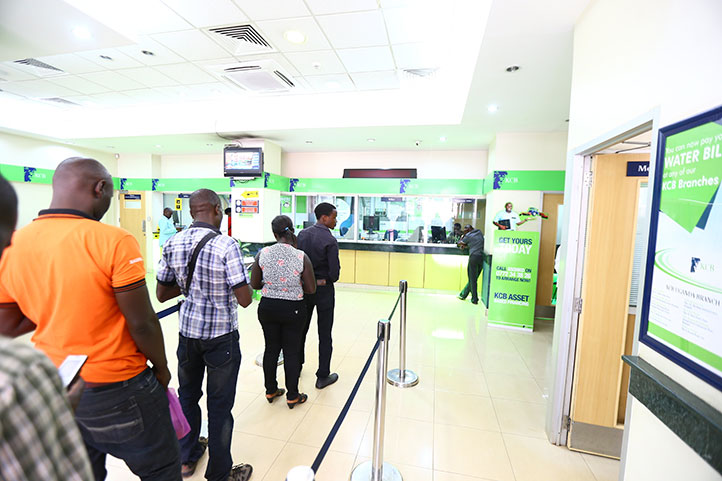
It is an open secret that interest rates explain the obnoxious profits that banks make in a sea of poverty called Uganda.
Among the highest in the world, interest rates in East Africa have made commercial banks in this region, “the most profitable in the world while being the least efficient,” as per The Economist.
However, despite our collective poverty as a country, it is usual for ordinary Ugandans to condemn businesspersons struggling under the weight of loans that that is singularly their individual problem.
Dear reader, we ought to be kinder. In fact, we ought to build solidarities with holders of the so-called non-performing loans: That is because:
(a) lenders in Uganda are not designed to grow their borrowers, but use them as the straw through which an entire society’s toil and sweat is syphoned.
(b) It is not when the borrower finally collapses and the business taken over that banks cash in big. That is just the final stage when the parasite finally kills its host. Banks milk Ugandans, collectively, when businesspersons are painstakingly servicing their loans.
I will start this story from the beginning.
When only banks thrive
Last week, news outlets reported that Absa (formerly Barclay’s bank) made Shs 146 billion in net profits in six months. By this trend, Absa will make Shs 292 billion ($76.8m) at the end of the year.
It also means that Absa makes Shs 24 billion ($6.35m) — in monthly net profit. How is Absa able to make this money in an economy where all other supposedly major businesses are literally and practically on their knees? Consider that Absa is just one of the five big banks that would be said to be operating within the same profit margins. The math is mindboggling.
See, if Stanbic bank, Absa, dfcu bank, Centenary bank, and Standard Chartered bank each made $76.8 million, this would make $384 million in net profits for these five banks. There are 25 banks in Uganda. I will rephrase my question: in an economy that is barely surviving, with whom are these banks trading?
Through 2016-2021, newspapers have published lists of supposedly major businesses that have practically remained on their knees — and are still on their knees as I write — begging government to bail them out.
The list remains long and shocking: Roko Construction, Simba Telecom, Biyinzika, Freedom City Mall, Shumuk Aluminium Industries, Roofings Limited, Grapes Construction, Ham Enterprises, Senana Enterprises, Ssebagala and Sons, Club Silk, and many, many others.
Please note that this list contained only those persons/businesses connected enough to buy their names onto the list. And all these are fairly big businesses. The small ones stand no chance.
The conclusion here is that this is clearly a stupid economy. And something is terribly wrong when only lenders are thriving. In sum, it is extraction. But we need to put this extraction into perspective. It is not extraction from just the individual borrowers, but the collective toil and sweat of every Ugandan.
Interest rates, collective sweat
When a bank agrees to extend a loan to anyone, they have to do due diligence to ascertain the creditworthiness of the borrower. But this creditworthiness inquiry is not just an assessment of that individual borrower; it is also an assessment of their entire line of business in which the borrower is involved and the people working with that person.
Thus, it as an assessment of many, many people, which is oftentimes, everyone else, including the vendor on the street selling cookies outside of the borrowers’ offices – including the night girl they will visit after work. Thus, when a borrower takes money from a commercial bank, they are taking it on behalf of and on the strength of the productivity of an entire ecosystem. The creditors have their eyes on this ecosystem, which is actually the entire country.
I know that the individual businessperson offers collateral, but please note that he does this on behalf of everyone in their line of business. All sound economists will tell you these linkages are often convoluted, multidirectional, and non-linear.
I will use a boda boda ride to explain this mass sweat extraction. When a businessman hires a boda boda rider, it is common to see the boda boda rider as the only beneficiary as he gets paid at the end of the journey. It is unusual to see a customer as one who also has a material benefit from this boda boda ride. (Maybe when they refuse to pay).
But you ought to understand that for the businessman to jump on a boda boda, the businessman has calculated that what they will pay for the services and labours of a boda boda rider is less than what he would have gained from their services.
In other words, the businessman is not just a customer, but a boss who hired the services of a labourer. Yes, in any such transactions, when a labourer earns a salary, the boss earns a profit (often calculated at the end of a business cycle). Recall then that what is called profit is actually labour that the boss does not pay for, but cordially and without coercion gets it from the labourer.
The labourer is actually happy with their half-labour salaries because it is allegedly sufficient for their needs. Note, however, that for the boda boda rider to be content with being paid less (which oftentimes looks enough, and they never complain — their other life demands of the boda rider are catered for or are subsidised by other means, including the unpaid labours of wives at home or a family garden from which they get “free food” or the public purse. But then, it is the boss/customer who employed this boda rider who enjoys all these free things because he does not pay for all the labour he gets from the rider.
But then, the businessman has to pass all his profits as loan-interest while servicing the loan. When a borrower (Simba Telecom, Freedom City, Shumuk, Biyinzika) gets money from the bank, the claim is that these businesses will pass this money down the chain. However, in the process, they are sucking all the toil and sweat of everyone who gets to touch any penny from the bank.
In sum, you do not have to be banked to be expropriated by the banks. You only have to work. As long as you offer any labour or service, at whatever level — including night girls — banks have their blood-sucking mandibles in your pants.
Ever wondered why it is difficult for nationals to start and run a bank in Uganda? Besides the inexplicable, why does one need Shs 125 billion ($35m) to open a bank — when most borrowers never exceed Shs 25 million for credit?
For whom was this legislation made? Why doesn’t every district in Uganda have its own local bank designed to respond to local borrowing demands as happened in 18th Century Europe?
yusufkajura@gmail.com
The author is a political theorist based at Makerere University
Source: The Observer
Share this content: