


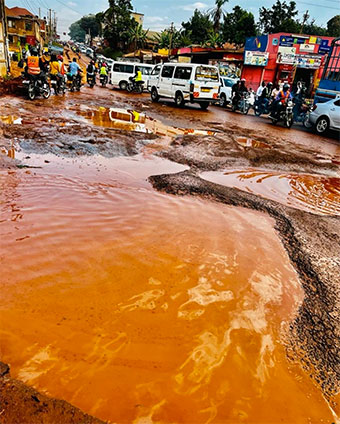
In April last year, the Kampala Capital City Authority (KCCA) received over Shs 11 billion to address the pothole crisis in Kampala city.
This funding was prompted by a public outcry on social media, particularly on X, regarding the deplorable condition of the city’s roads. The online campaign revealed that most roads in Kampala were in disrepair, leading President Museveni to direct the ministry of Finance to release Shs 6 billion specifically for pothole repair in the city. An additional Shs 5.5 billion was subsequently obtained from the Uganda Road Fund.
In an interview discussing how the Shs 11 billion was utilized and the ongoing road construction efforts around Kampala, Justus Akankwasa, the director of Engineering and Technical Services at KCCA, provided insights. He explained that many roads in Kampala have exceeded their designed lifespan and require complete reconstruction rather than simple pothole patching.
“Roads have to be rehabilitated after 10 to 20 years, but the roads we are talking about were constructed during colonial times,” Akankwasa stated.
“You patch a very old road, and what you have patched is stronger than what is around it; clearly, a pothole will develop somewhere else.”
Akankwasa’s remarks highlight the broader issue of aging infrastructure in Kampala. The temporary fixes funded by the Shs 11 billion allocations are insufficient for roads that have long surpassed their intended durability.
The ongoing deterioration points to a need for comprehensive reconstruction efforts to ensure long-term road quality and safety for Kampala’s residents. Kampala city boasts a total road network of 2,100km, of which only 646km (30%) are paved.
The road network is distributed among Kampala’s divisions as follows: Central has 178km, Nakawa 539km, Lubaga 464km, Makindye 502km, and Kawempe 428km. However, many of these paved roads have outlived their intended lifespan, resulting in numerous potholes that pose significant hazards to the city’s residents.
Eng. Akankwasa, detailed how the Shs 11 billion allocated for pothole repairs was utilized. The funds were distributed to rehabilitate roads across Kampala’s five divisions. Specifically, Shs 2 billion was allocated to UPDF engineers for patching roads in the city center, while the remainder was given to KCCA division engineers to address roads in other divisions.
MORE FUNDS NEEDED
Akankwasa emphasized the need for the government to allocate more funds for road maintenance to ensure they are rehabilitated within their intended lifespan, thereby extending their durability. “The government should allocate more money to the Uganda Road Fund to maintain roads early. When you start maintaining early, you’re easily prolonging their life,” he explained.
Regarding current road projects, Akankwasa highlighted several ongoing initiatives aimed at improving Kampala’s road network. These projects are funded through various sources, including the government’s regular budget, the Uganda Road Fund, and a grant from the Japanese Inter- national Cooperation Agency (JICA).
“We have projects funded by the government under the normal budget, others under the Uganda Road Fund, and a grant we got from the Japanese International Cooperation Agency (JICA),” he said.
Akankwasa explained that KCCA received a grant of Shs 67 billion from the Japanese International Cooperation Agency (JICA). With this funding, KCCA is phasing out roundabouts and plans to signalize about 27 junctions to improve traffic flow in the city.
“All the signalized junctions will be linked to the KCCA headquarters, and traffic will be managed automatically, especially during peak hours, to avoid congestion as it is always,” he said.
Some of the completed junctions include the Nakawa Spear Motors junction, Katalema road junction, New Vision junction, All Saints junction, Kubili, and Mulago roundabouts, which are yet to be finished, as well as others along the way.
In addition to the JICA grant, KCCA has also benefited from funding by the African Development Bank for several road construction projects. Under Lot 1, they have completed roads such as Wamala road (approximately four kilometers long), Luwafu, Kabega, Mutesa 1, Kigara, Old Mwende road, and Kiyemba road, which is yet to be completed.
Under Lot 2, Port Bell road and Spring road are currently under construction. Lot 3 includes 8th Street, 7th Street, 6th Street, 5th Muzito, and Suna Road. Lot 4, which began in December, covers Queen’s Way, Kasubi Northern Bypass, Salama road, Kyebando Ring road and Kisaasi road. Lot 5 includes Mugema, Masiro and Sentema roads.
Akankwasa further stated that KCCA plans to embark on more projects in this financial year with additional funds from the World Bank.
WHY CHINESE FIRMS FOR ROAD CONSTRUCTION?
Concerns have often been raised by Ugandans about the government’s preference for foreign companies, particularly from China, over local firms for government projects. Akankwasa clarified that according to the PPDA regulations for procurement, if contracts exceed $4.5 million, an international bid is required. This stipulation means local companies must compete with international firms.
“At the international level, everyone is given a chance to bid, both local and international companies. In most cases, local companies are outcompeted due to a number of reasons,” he said.
Akankwasa explained that local companies are frequently outpriced and disadvantaged by the bank interest rates they face.
“The cost of financing is different. For example, when a local company borrows money from a Ugandan commercial bank, they will be charged an interest rate of 19%, whereas a Chinese company is charged 3% by a bank in China,” he said.
Additionally, foreign companies often reduce their prices to levels that local companies cannot match, leading to their continued struggle to compete with international firms.
Source: The Observer
Share this content: