


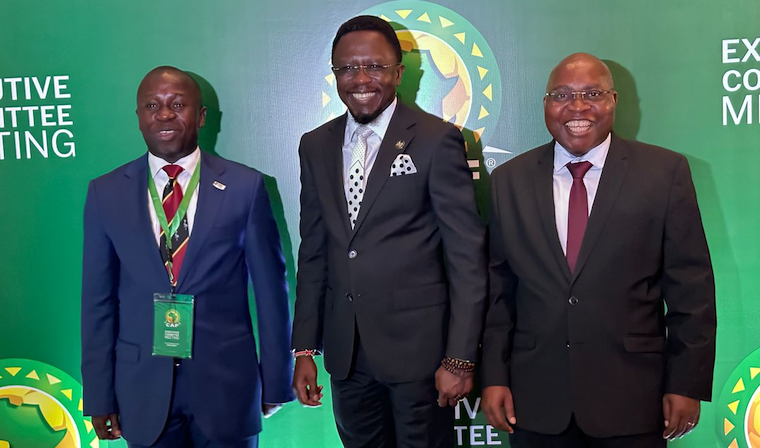
Last week in Cairo, the CAF executive committee voted to award the hosting rights of the 2027 Africa Cup of Nations to Kenya, Uganda and Tanzania.
It was a historic decision because it is the first time the tournament will be played in three countries. Immediately after CAF’s announcement, social media became awash with negative connotations around an Afcon in the region.
Many Ugandans and Kenyans, in particular, have chosen to throw disdain at the idea of their countries hosting Africa’s biggest football competition.
Normally, countries should be celebrating the successful conclusion of a tiresome process that involves preparation of a bid, inspections from officials from the continental governing body, securing of government guarantees and back-and-forth lobbying in the days and hours leading up to the vote.
Instead, the full-scale contempt shows beggars’ belief. The sentiments on most social media sites create the impression that CAF committed a horrendous mistake in picking East Africa over Algeria, Nigeria and Benin, and Senegal.
A simple glance at recent soccer events shows that this disparagement comes with the territory. In 2004, when South Africa was picked to host the Fifa World Cup, the entire Western media attempted to convince the world that Fifa had committed the greatest sin in awarding their showpiece event to Nelson Mandela’s country.
We were told that South Africa’s crime rates were going to endanger World Cup tourists. We were told that the country’s lack of a first-class transport system was going to make it a nightmare tournament for the 500,000 visitors in the winter of June and July. There was a particular article in The Guardian newspaper by a journalist called Louise Taylor titled ‘Why going to South Africa for the World Cup terrifies me’ that highlighted the so-called dangers associated with a World Cup in Johannesburg, Durban, Cape Town and the other host cities of the 2010 edition.
To cut the story short, the SA World Cup happened. And it was a huge success. As one American fan I met in Rustenburg put it, “They warned me about the water in South Africa but when I drank it, it tasted better than what we take back home.”
Four years later in 2014, there was a lot of nonsense that was said and written about the tournament in Brazil. There was selective coverage of sit-down strikes by workers on construction sites, the dengue fever, the Zika virus and the country’s crime rate.
Regardless, Brazil 2014 happened. Memories from that tournament are not the pre-tournament negativity that was propagated by sections of groups who had a hideous motive. What we remember are memorable games like Germany crushing Brazil 7-1 in that famous semi-final at Estadio Minerao in Belo Horizonte.
We were told similar tales on why Russia 2018 would be a wrong World Cup to attend. Last year, the world nearly united in arms to tear down everything Qatar had put in to host the first World Cup in the Middle East. When it ended, it was hailed as one of the best tournaments ever because of being a one-city World Cup.
Cameroon, who hosted the last Afcon, were also criticized by forces inside and outside the country. That didn’t stop the country from building legacy stadiums and staging a successful tournament.
As Danny Jordaan, the CEO of the SA 2010 Fifa World Cup, said one year after the tournament, “the best thing for us was the criticism that was directed to our organizational efforts because people arrived in our country with extremely low expectations and departed South Africa impressed with what we showed them.”
Therein lies the opportunity for Kenya, Uganda and Tanzania come Afcon 2027. That negativity could be the best thing to happen for the local organising committee of Pamoja 2027.
The writer is a sports journalist and has attended the last four Fifa World Cups from start to finish
Source: The Observer
Share this content: