


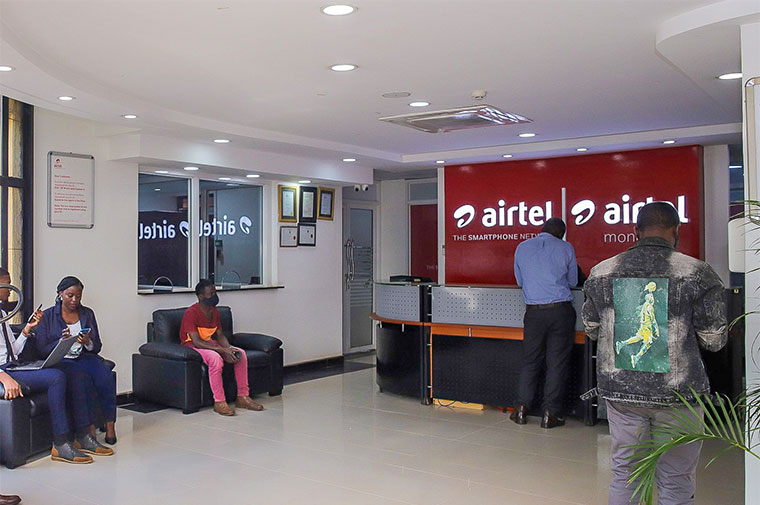
I know telecom companies the world over promise more than they can deliver, especially when it comes to Internet speeds.
But I have never experienced a situation, until now, where you pay for a service and the company turns around to say you didn’t pay for it! I haven’t had home Internet for almost a week because Airtel insists I owe them money and yet I do not
owe them.
Last year, I signed up to become an Airtel Internet customer. Their branded work order clearly states, “NB: Client has paid for 6 months (effective June) and will run until end of Jan 2023.”
I was told before I made the order that if I pay for six months in advance, I will get an extra one month free. Accordingly, I paid in advance for another six months, meaning from 2 February 2, 2023 to July 31, 2023, plus one free month ending on August 31, 2023. Nothing was said to me at the time. Instead, I was cut off by Airtel even before the end of July, allegedly for non-payment!
For the first time on July 3, 2023, the Airtel agent called Joseph Katende who processed my order informed me that Airtel had discontinued the free month. He said that meant my subscription ended in June 2023. He claimed an email to that effect was sent to all clients.
I didn’t receive any email from Airtel. When I asked for a copy of the email, Joseph told me that Airtel couldn’t “trace” it. That’s what the Americans call “bait and switch.”
I tried various means to contact Airtel to resolve the issue without any luck. The number (0705100100) and Twitter account listed on their website were not helpful. There is no email or WhatsApp contact (Their rival MTN has all those).
To their credit, Airtel’s Cabrine Makeba and Keith Namanya tried to help but the issue lies outside their competence. If that is not daylight robbery, I don’t know what it is.
F. Kirungi
Kampala
Bring back operation Fika Salama
Following the continuous road carnages on different highways, there is need to reinstate Operation Fika Salama as an intervention in a bid to contain fatalities on Ugandan roads.
Launched in 2016 by Uganda National Roads Authority and enforced by Traffic Police and other sister agencies, Operation Fika Salama was a special intervention aimed at checking on errant drivers on major highways.
Several checkpoints were erected on various roads but whereas these are still available, they have not been as serious as they were in 2016. As time has gone by, there have been new black spots on the roads which also need to be manned day and night as well as increasing regular patrolling.
A number of motorists drive recklessly because they know very well that there is no one who can intercept or caution them on this dangerous vice.
We wouldn’t have experienced such road crash cases if Uganda Police Force used the same effort in its operations of tracing, arresting, detaining and prosecuting truck drivers carrying charcoal from Northern Uganda and West Nile as a way of implementing the presidential directive on protecting the environment.
This operation has now made a number of these drivers and those dealing in charcoal to pay fines and serve punishments. This has forced them to run away from this business hence reducing deforestation in the Northern region and West Nile.
Operation Fika Salama will be the only solution than coming up with new laws and regulations. It will curb the increasing number of drivers who overtake in dangerous spots, over speeding, drunken drivers, cars in poor mechanical conditions, unauthorized drivers and those on phones while driving.
Operation Fika Salama is the immediate solution which will save Ugandans from these continuous road carnages as the government is looking at long- term solutions like installing lights on all highways and keeping roads in good shape.
Implementing the existing laws using Operation Fika Salama will be the easiest, quickest and less costly way of maintaining road traffic rules, helping police to crack down on motorists with unpaid Express Penalty Scheme tickets. Operation Fika Salama will swallow all those evil acts on the road.
David Serumaga,
Luweero.
Ugandan law enforcement officials are lax
Close to a dozen people, including businessman Apollo Nyegamehe alias Aponye and former Erute North Member of Parliament Charles Engiro Gutomoi, died in three separate road crashes in Western and Northern Uganda within a space of four days.
Their vehicles ran into stationary trucks that had broken down on the road. Many other travellers have died in a similar manner on Ugandan roads and the situation is likely to continue unless deliberate steps are taken to mitigate the problem.
In his speech delivered by Vice President Jessica Alupo at the burial of Aponye, President Yoweri Kaguta Museveni directed the Attorney General to propose amendments to section 58 of the Road Act 2019, with the view of making it more implementable.
Section 58 (1,2, 3, and 4) provides the time frame within which vehicles that break down on the road should be removed. While the president has a valid concern, amending the law will not solve the problem.
As a regular traveller on our roads, I can state without fear or hesitation that the problem isn’t with the law. The problem lies with implementation, just like many other problems the country is grappling with. There is a lot of laxity when it comes to enforcement of rules in the country.
I have on various occasions seen stationary trucks in very dangerous spots, even when some of them just need a few men to push them to safer areas for the safety of other road users.
While the law provides for around two and six hours for the removal of such vehicles depending on the particular situation, I think the traffic police ought to make a correct judgment and act accordingly.
Ahmed Wetaka,
Kampala
letters@observer.ug
Source: The Observer
Share this content: