
- Equity Group’s regional subsidiaries lift contribution to nearly half of banking profits in the nine months to September while non-funded income climbs to 44% of total revenue.
- NPL ratio falls to 9.3% and cost-to-income improves to 47.9% on stronger underwriting and efficiency gains.
- Deposits rise 19% to KSh1.58 trillion and loans expand 17% to KSh1.01 trillion, pushing total assets to KSh2.15 trillion.
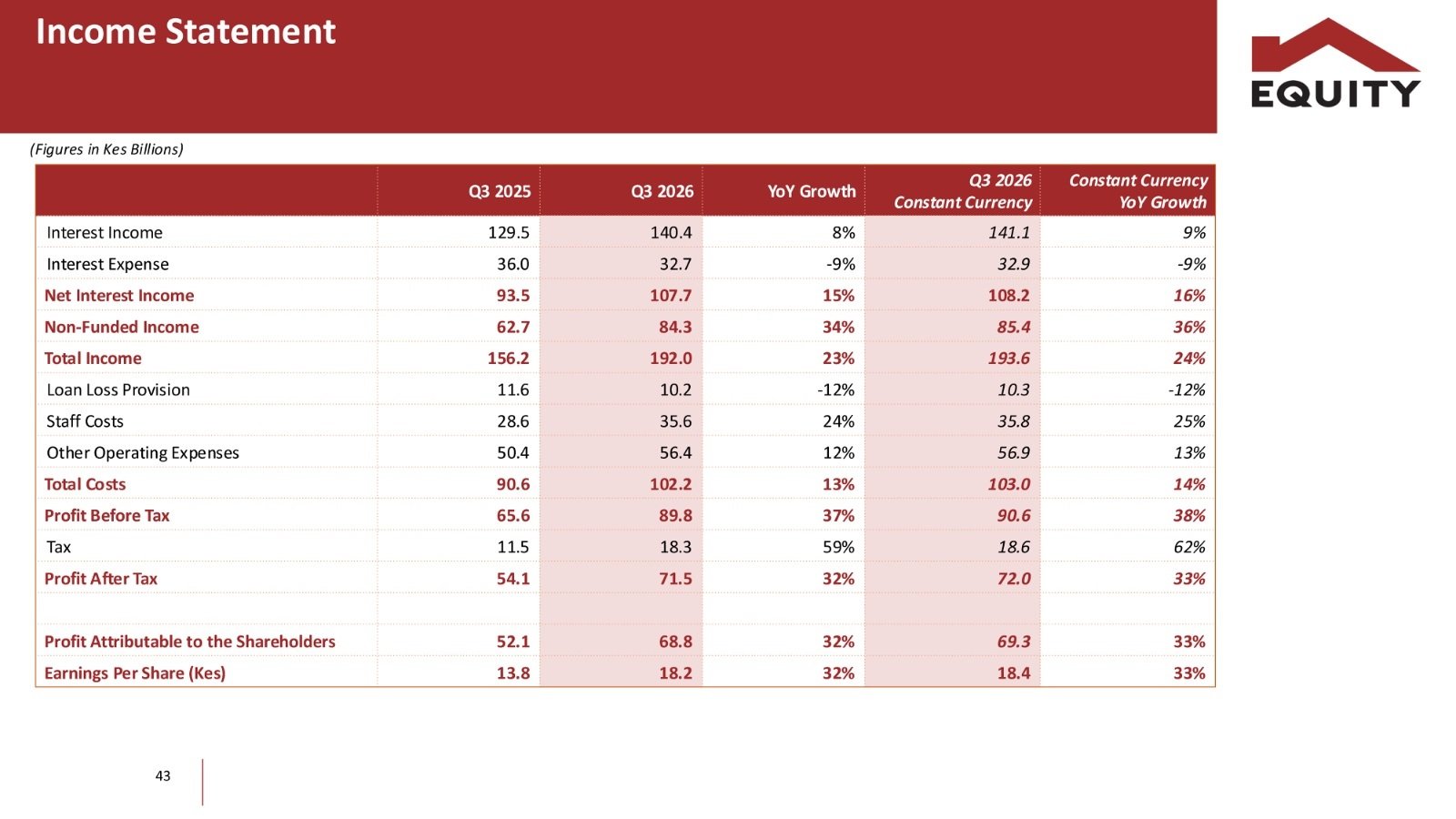
East Africa’s banking giant, Equity Group, has reported a sharp rise in third-quarter earnings, with net profit climbing by 32 per cent year-on-year to KSh71.5 billion (about $550 million) for the nine months ended 30 September 2026.
Profit before tax advanced 37 per cent to KSh89.8 billion ($690 million), reflecting broader balance-sheet growth, improved asset quality and rising contributions from regional markets and non-banking businesses.
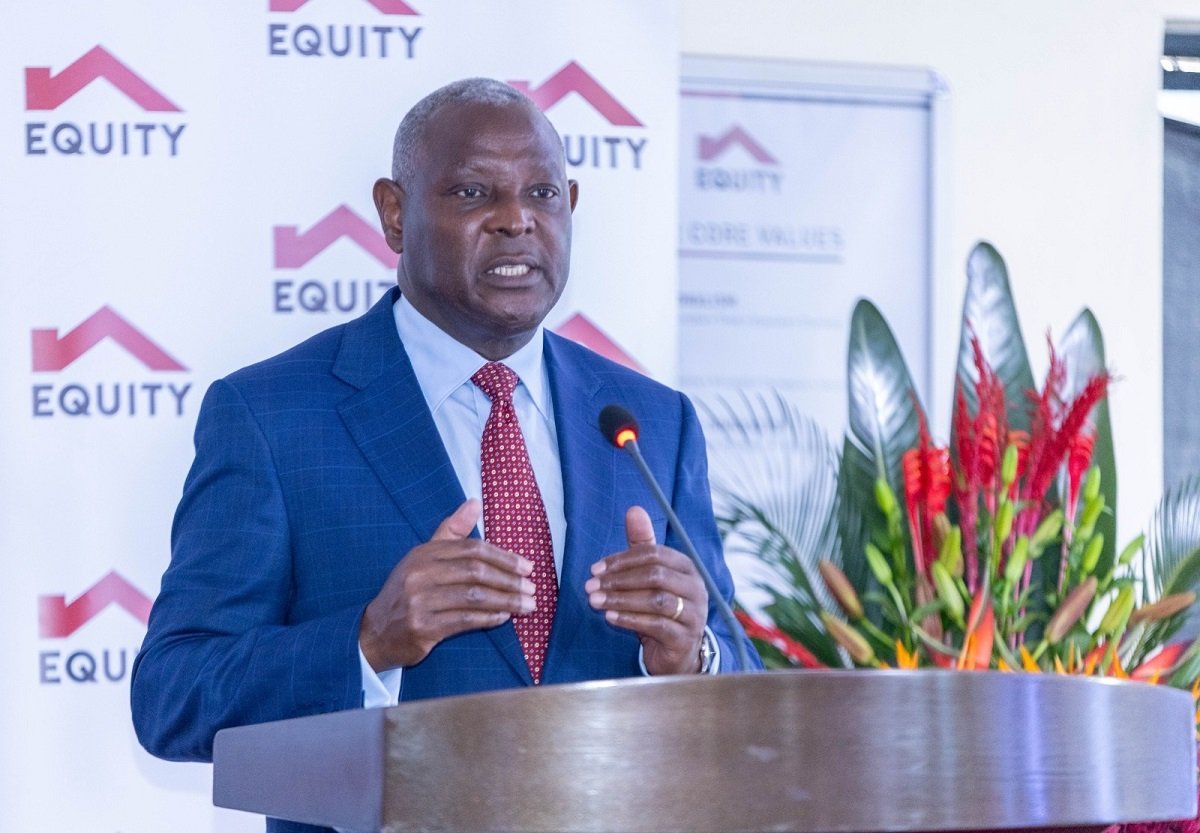
The results, released in Nairobi, show the group continuing to execute a multi-year strategy centred on regional expansion, digital delivery and diversification beyond traditional interest income. Group CEO Dr James Mwangi said the performance validated the long-term transformation agenda that has strengthened resilience and operational scalability.
Equity Group earnings and revenue mix shift
Net interest income rose 15 per cent to KSh107.7 billion, supported by lending growth and disciplined balance-sheet management. Total operating income increased 23 per cent to KSh192.0 billion. Non-funded income was the standout contributor, surging 34 per cent to KSh84.3 billion and lifting its share of total income to 44 per cent from 40.1 per cent a year earlier. The rise underscored growing customer activity across digital channels, payments, insurance and other fee-generating businesses.
Return on average assets stood at 4.6 per cent while return on average equity reached 27.2 per cent, pointing to solid capital productivity. The cost-to-income ratio improved to 47.9 per cent from 50.6 per cent, driven by productivity gains, shared services and the continued migration of transactions to lower-cost digital platforms.
Balance-sheet expansion and cleaner asset quality
Customer deposits grew 19 per cent to KSh1.58 trillion from KSh1.33 trillion, while net loans expanded 17 per cent to KSh1.01 trillion from KSh859.8 billion. Total assets increased 18 per cent to KSh2.15 trillion. Shareholders’ funds rose 22 per cent to KSh369.7 billion, reinforcing capital buffers.
Asset quality continued to improve. The non-performing loan ratio declined to a single-digit 9.3 per cent from 12.1 per cent, cost of risk fell to 1.5 per cent from 1.9 per cent, and NPL coverage remained steady at 71 per cent. Management attributed the progress to tighter underwriting, stronger analytics and portfolio diversification across markets and segments.
Equity Bank Kenya, the group’s largest unit, reported a 31 per cent increase in profit after tax to KSh40.7 billion. Its assets grew 7 per cent, supported by 10 per cent deposit growth and 12 per cent loan growth. Return on average assets and equity at the Kenyan bank stood at 5.1 per cent and 35.2 per cent respectively. The bank maintained its leadership in the micro, small and medium enterprise segment, disbursing 34 per cent of the KSh245 billion in MSME loans issued in Kenya in the first half of 2026.
Regional franchise gains traction
Regional subsidiaries accounted for 42 per cent of group banking profitability, 50 per cent of banking revenue, 54 per cent of deposits, 55 per cent of loans and 54 per cent of banking assets. Equity BCDC in the Democratic Republic of Congo lifted profit after tax 34 per cent to KSh18.5 billion. Equity Tanzania delivered the strongest percentage growth, with profit after tax rising 60 per cent to KSh2.4 billion, while Equity Rwanda advanced 10 per cent to KSh4.4 billion.
“The Group’s regional businesses continued to gain scale and deepen their contribution to earnings,” the statement noted. Management highlighted Tanzania, the DRC and Uganda as leaders in loan growth across corporate, retail, MSME and public-sector segments.
Read also: Equity Group backs global investors eyeing DRC’s multi-billion-dollar frontier
Insurance and non-banking businesses accelerate
Equity Insurance Group recorded a 52 per cent rise in gross written premiums to KSh10 billion and a 34 per cent increase in profit before tax to KSh1.96 billion. Life insurance contributed KSh7.5 billion of premiums, health KSh1.3 billion and general insurance KSh1.1 billion. Life policies issued reached 23.7 million, covering 7.3 million unique customers. Eighty per cent of policies were distributed digitally. Non-banking businesses as a whole increased their share of group revenue to 4.5 per cent from 3 per cent.
Digital scale and human-capital investment
Customer behaviour continued to shift decisively toward digital channels. Some 98.3 per cent of transactions were conducted outside branches and 89.5 per cent were processed digitally. The group serves more than 24 million customers through a network that includes Equity Online, the Equity Mobile App, *247#, Equitel, 411 branches, 883 ATMs, 95,510 agency outlets and 1.4 million merchants.
Investment in technology and skills remained intense. Ninety-seven per cent of staff completed a business-focused generative AI course and staff collectively logged 163,860 hours of guided AI instruction. More than 2,600 employees were admitted to master’s programmes in financial engineering and strategic AI and innovation through WorldQuant University.
Dr. Mwangi said the group remains confident in the resilience of its markets despite global geopolitical uncertainty and inflationary pressures in some countries. Kenya is expected to grow 4.5–5 per cent, while regional subsidiaries operate in some of the world’s faster-growing economies. The group is advancing its Africa Recovery and Resilience Plan 2030, which targets expansion to 15 countries and 100 million customers, underpinned by next-generation digital and AI systems.
Equity Group remains well capitalised, with buffers management describes as sufficient to support its strategic objectives. The Q3 results met or exceeded internal guidance across key performance indicators, reinforcing the view that the diversified, technology-enabled model is delivering sustained growth.
Read also: Equity Group’s regional foray powers $351M H1 profit as Kenyan unit cedes dominance
(129KSh=1US$)

Leave a Reply