
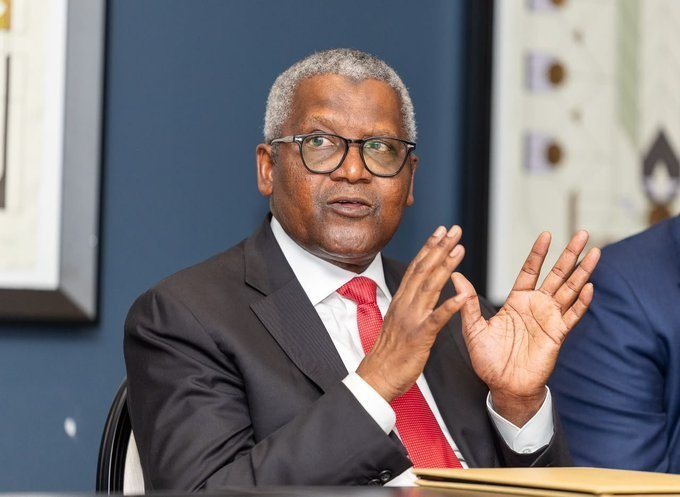
- Africa’s richest man’s cement group abandons planned UK float after board review; shares to remain solely on Nigerian Exchange. Move deals fresh blow to London’s struggling listings market amid equity volatility. Dangote Industries Limited insists that its operations and strategy unaffected.
Dangote Cement Plc, controlled by Nigerian billionaire Aliko Dangote, has abandoned plans for a secondary listing and share offering on the London Stock Exchange, the company announced on Tuesday following a board meeting.
In a notice filed with the Nigerian Exchange Limited, the group and its selling shareholder, Dangote Industries Limited, said they would “not proceed with the proposed secondary listing and offering on the London Stock Exchange at this time” in light of current market conditions and the company’s strategic priorities.
Ordinary shares will continue to trade solely on the NGX. The decision “does not in any way affect the company’s operations or business plans,” the statement added. Dangote Cement “remains focused on delivering sustainable value to its shareholders and building on its strong market position.”
The announcement ends months of preparation for what would have been one of the more significant African listings in London in recent years. It comes as the UK exchange continues to grapple with a prolonged drought of new flotations and a string of high-profile departures.
Dangote Industries Ltd decision follows rapid shift in market tone
Dangote Cement first signalled serious interest in a London secondary listing in May 2026. At the time the company, then valued at roughly $12-13 billion on the Nigerian market, said it was in early talks.
Shareholders later authorised the board to pursue a secondary listing on the LSE or another recognised international exchange, subject to regulatory approvals. The proposed transaction was expected to involve the sale of around 10 per cent of existing shares by Dangote Industries Limited, raising approximately $1 billion for the selling shareholder rather than new capital for the company itself.
Preparations accelerated through the months after with Aliko Dangote visiting the London Stock Exchange in late October. Advisers including major international banks had been engaged, and management conducted roadshows in London, the Middle East and South Africa. A capital markets day was held in London in September as part of efforts to court international investors.
The sudden reversal has been linked by sources familiar with the matter to recent equity market turbulence. Global stocks sold off sharply in the wake of the US midterm elections and a broader rotation away from technology and artificial-intelligence related shares. London’s FTSE 100 also finished the previous week lower. One person close to the situation told Reuters the company may revisit the listing once greater stability returns.
London Stock Exchange’s listing challenges deepen
The withdrawal is another setback for London. The city has struggled for several years to attract major new international issuers, with secondary listings and dual listings also becoming harder to complete in volatile conditions. Dangote Cement would have joined a small group of Nigerian companies with a London presence, including Seplat Energy and Guaranty Trust Holding Company.
Dangote Cement is Africa’s largest producer of building materials and remains one of the most heavily traded stocks on the Nigerian Exchange. Its shares have performed strongly in 2026, rising more than 140 per cent year-to-date at points and supporting a market capitalisation of around 24.8 trillion naira, or approximately $18.4 billion.
The group operates across multiple African markets and forms a core part of Aliko Dangote’s wider industrial empire, which also includes sugar, fertiliser and the recently floated Dangote Refinery.
The refinery’s initial public offering on the NGX earlier this year attracted heavy domestic demand, underscoring the depth of local capital available for high-profile Dangote assets even as international appetite for secondary listings has proved more fragile.
Read also: Dangote GDR signals Africa’s slow march toward integrated capital markets
Strategic focus remains on Nigerian market
Company officials have stressed that the London decision does not signal any change in underlying business strategy. Production, expansion plans and day-to-day operations continue unaffected. The primary listing on the NGX provides the liquidity and investor base the company currently prioritises.
Analysts following African markets noted that the strong performance of Dangote Cement shares in Lagos reduced the urgency of seeking deeper international liquidity at a moment of heightened global risk aversion. A secondary listing remains an option rather than a necessity for funding, given the company’s cash generation and the controlling shareholder’s capacity to hold the bulk of the equity.
The formal notice was signed by company secretary Edward Imoedemhe and released after the board meeting on 10 November. No revised timetable was provided. Market participants will now watch whether the group revisits international listing plans once volatility subsides or whether it doubles down on deepening its domestic free float and regional African listings instead.
For the London Stock Exchange the episode highlights the continuing difficulty of attracting large emerging-market corporates when global risk appetite weakens. For Dangote Industries it underscores a pragmatic approach: the group is prepared to walk away from a high-profile international transaction when pricing and demand conditions fall short of internal hurdles.
Dangote Cement shares continue to trade on the Nigerian Exchange under the ticker DANGCEM. The company has made clear that its operational trajectory and long-term value creation strategy remain unchanged by the decision to pause the London plan.
Read also: How Dangote’s $2.5bn fuel hub could reshape Southern Africa’s oil supply map

Leave a Reply