
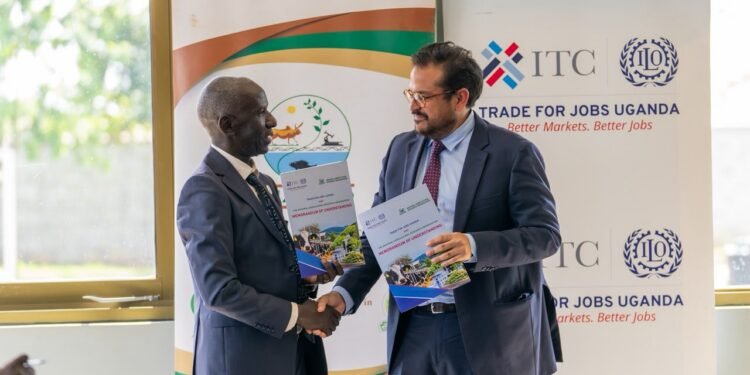
WAKISO — Uganda’s rapidly expanding dairy industry could generate more jobs and higher farmer incomes under a new partnership between the National Agricultural Research Organisation (NARO) and Trade for Jobs Uganda aimed at accelerating the adoption and commercialisation of agricultural technologies.
The partnership seeks to address a longstanding challenge in Uganda’s agricultural sector: translating research innovations into practical technologies that farmers, processors and other businesses can use to increase productivity, improve product quality and compete in local and international markets.
The two organisations signed a Memorandum of Understanding (MoU) on November 2, 2026, at NARO’s National Livestock Resources Research Institute (NaLIRRI) in Nakyesasa, Wakiso District.
The agreement comes as Uganda’s dairy industry records significant growth in production and export earnings, raising the stakes for investments in technology, value addition and market access.
According to the Ministry of Agriculture, Animal Industry and Fisheries (MAAIF), national milk production increased from 2.7 billion litres in 2020 to 5.4 billion litres in 2024.
The value of milk and milk product exports also rose from $264.5 million in 2023 to $285.4 million in 2024.
However, sustaining this growth will require more than increasing the number of litres produced. Farmers and dairy businesses need access to technologies that address livestock diseases, improve animal productivity, reduce production costs and strengthen the processing and marketing of milk products.
NARO Director General Dr Yona Baguma said Uganda had invested considerably in agricultural research, but the next priority was ensuring that innovations reach the people and businesses capable of turning them into economic opportunities.
“Uganda has invested significantly in agricultural research and technology development. The opportunity now is to ensure that technologies generated through research reach farmers, businesses and other actors who can use them to improve productivity and incomes,” Baguma said.
He said the dairy subsector presents significant opportunities for employment and enterprise development, particularly as demand for milk and dairy products expands.
“We must now move from being catalytic to being truly impactful. Uganda’s dairy subsector is transforming rapidly and presents tremendous opportunities for individuals and enterprises to secure sustainable livelihoods,” he added.
Baguma cited NARO’s anti-tick vaccine as one of the innovations with potential to improve livestock production while creating additional employment opportunities along the livestock value chain.
The vaccine is part of NARO’s efforts to develop solutions to livestock production challenges, including tick-borne diseases that affect animal health and farmers’ productivity.
Under the agreement, the two organisations will work with dairy processors, farmer cooperatives, milk collection centres and agro-dealers to promote the development, transfer and commercialisation of technologies generated through agricultural research.
A major component of the partnership will involve designing and testing business models through which private-sector players can help farmers access and adopt appropriate technologies.
The organisations also intend to strengthen market information systems, knowledge sharing and engagement among stakeholders to ensure that research responds to the practical needs of dairy businesses.
NARO will identify suitable technologies, provide technical expertise and research information, and coordinate commercialisation strategies, while Trade for Jobs Uganda will offer technical assistance in developing and scaling market-oriented technology transfer interventions.
Fernando Martinez Cure, Chief Technical Advisor at Trade for Jobs Uganda, said the partnership would combine agricultural research expertise with market development approaches to ensure innovations translate into businesses and decent employment.
“This partnership brings together two complementary strengths: NARO’s expertise in agricultural research and technology development and Trade for Jobs Uganda’s expertise in decent work, market systems and inclusive economic growth,” Cure said.
He said the collaboration would help ensure that research innovations move beyond laboratories and research stations into productive enterprises and stronger markets.
Trade for Jobs Uganda identified dairy and tourism as two sectors with significant potential to expand trade and improve employment opportunities following a sector selection study.
The initiative focuses on addressing market constraints that limit business growth and employment, with particular attention to women, young people and people living in poverty.
The organisations expect the partnership to strengthen private-sector participation in agricultural technology transfer, creating opportunities for more farmers and dairy enterprises to benefit from research.
The MoU also provides for periodic review meetings to assess progress, address implementation challenges and identify areas for further cooperation.
The collaboration is expected to contribute to Uganda’s broader efforts to increase agricultural productivity, promote value addition and strengthen agro-industrialisation through a more commercially driven dairy value chain.
Source: PML Daily
Leave a Reply