
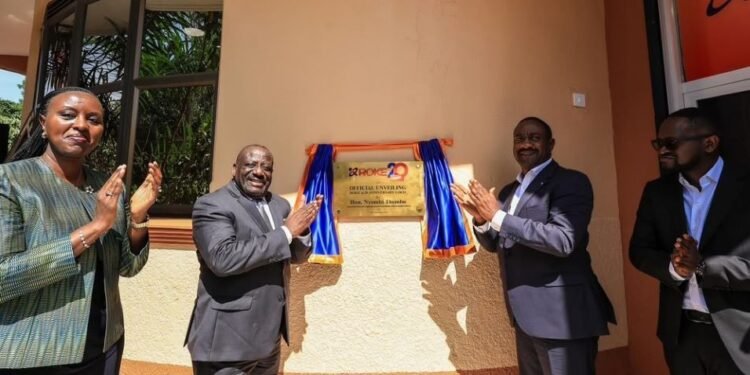
KAMPALA – Informal Wi-Fi hotspot operators cannot be licensed in their current form and must reform their businesses if they are to continue operating, the Uganda Communications Commission (UCC) has said.
George William Nyombi Thembo, the UCC Executive Director, made the remarks on Wednesday at the launch of celebrations marking 20 years of internet service provider Roke Telkom in Bugolobi, Kampala.
Nyombi Thembo said telecommunications was a highly regulated business and that no one could operate in the sector without a licence. He said the regulator recognised hotspot operators, popularly known as “hotspotters”, as a large group but had created a compliance pathway they must follow.
“As they are, there is no way they can be licensed. That one is impossible. We have to be very clear on that,” he said.
“Their business proposition, for lack of a better word, is founded on deceit. They must transform if they are to continue working.”
He also disputed what he described as a narrative that hotspot operators had introduced Wi-Fi to the country.
Nyombi Thembo said operators that could afford public service provider licences, including regional ones, should apply for them, while others could work as agents of licensed providers. He said both routes would require significant reforms to how the operators run their businesses, and that talks between the operators and the government would continue.
His remarks come four months after UCC launched a nationwide enforcement exercise against unlicensed public Wi-Fi providers in July. The operators, who sell internet access in neighbourhoods and trading centres, have argued that licensing requirements and costs are too high for small businesses. Last month, the government asked Parliament for two more weeks to resolve the dispute.
Nyombi Thembo thanked Roke Telkom for its agency model for hotspot operators, which he described as one of the regulator’s pathways. He also pledged to look into an outstanding matter raised by the company’s chairman, saying it was a sector-wide problem rather than one affecting Roke Telkom alone.
He said it was in the interest of the industry to build a sustainable and competitive internet service provider sector, supported by policies and regulations that encourage investment, innovation, infrastructure sharing and quality service delivery.
James Byaruhanga, a founder director of Roke Telkom, said price wars had been among the toughest challenges the company faced.
He listed other challenges as competition, inflation, staff turnover and global and geopolitical changes.
Byaruhanga said the anniversary covered the wider Roke group, which he said includes Roke Telkom, Roke Wood and Roke Cloud, as well as interests in Raxio Data Centre and Apparatus Uganda. He described the group as fully locally owned.
He said the company had been first to market with several services, citing a wholesale call termination business after the sector was deregulated, a fibre-to-the-home network and a public hotspot network.
Byaruhanga attributed the company’s survival to its directors’ active role in management, committed staff, a supportive regulatory environment and its readiness to introduce new products ahead of competitors.
Echoing Nyombi Thembo on infrastructure sharing, he called for a more organised market in which a few players build and run physical infrastructure while others lease capacity on it. He said Roke Telkom already worked this way, with six or seven internet service providers using its network to serve their own customers.
Roke Telkom was licensed by UCC in 2006 as a public service provider and later acquired a public infrastructure provider licence.
Byaruhanga said the sector was shifting from internet service provision to wider ICT solutions, and that the company would focus on cybersecurity, artificial intelligence, machine learning, the Internet of Things and e-mobility.
Peter Muhumuza, whom the company identified as its Chief Executive Officer, said Roke Telkom had started with the aim of widening internet access for Ugandans.
“Through resilience, investment and continuous innovation, we have grown beyond connectivity into a company providing ICT solutions that respond to the evolving needs of businesses and organisations,” Muhumuza said.
Source: PML Daily
Leave a Reply