
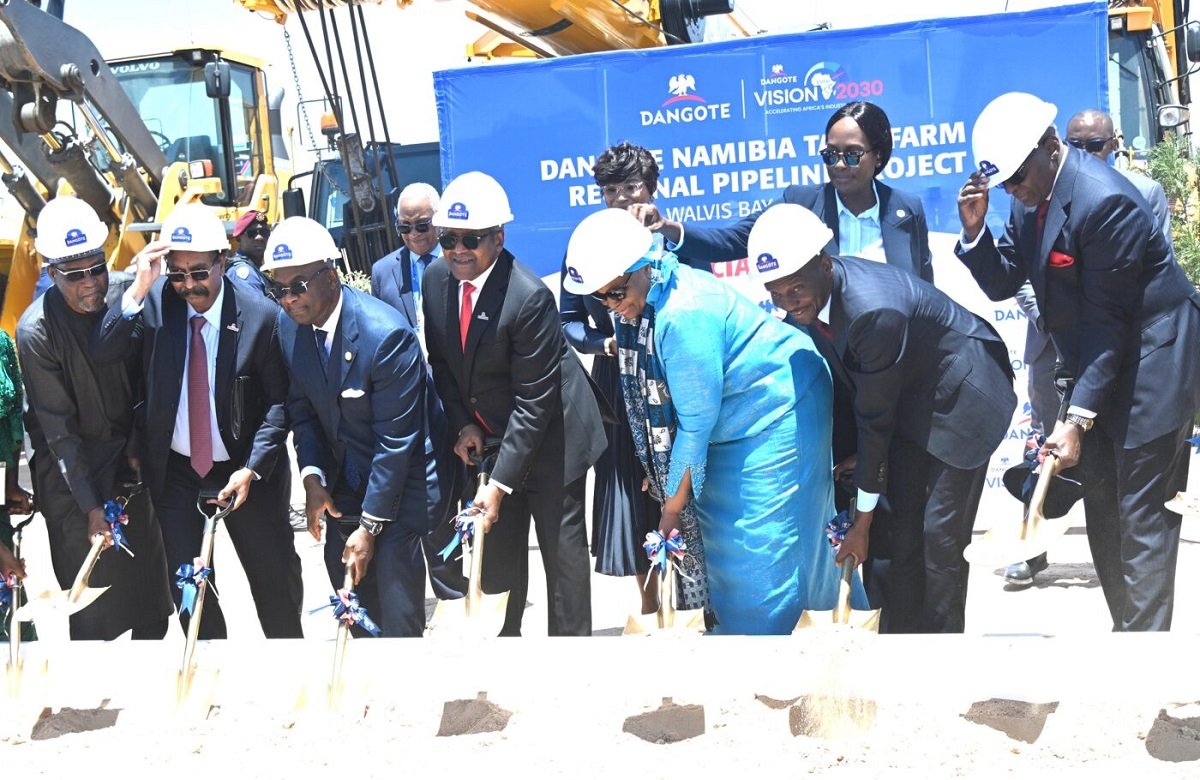
- Nigerian industrialist Aliko Dangote’s bet on Namibia’s coast promises cheaper fuel, deeper integration and a new logistics spine for landlocked economies, including Botswana, Zambia, Zimbabwe, Malawi and DRC.
Aliko Dangote has again placed a huge bet on Africa’s energy infrastructure deficit. On Wednesday this week, at a dusty site 10 kilometres east of Walvis Bay, the continent’s richest man and Namibia’s President Netumbo Nandi-Ndaitwah formally launched a $2.5 billion tank farm and regional pipeline project.
The facility is designed to store roughly 600 million litres of petroleum products, about four million barrels, eight times the capacity of Namibia’s existing national oil storage and to feed a 1,700-kilometre network stretching inland.
Dangote frames the venture as both commercial expansion and continental public good: lower prices for landlocked neighbours, reduced exposure to volatile shipping routes, and a concrete step toward the industrialisation he has long preached.
Namibian officials hail it as a landmark that will turn their Atlantic port into a southern African energy gateway. The regional stakes are higher still. Southern Africa’s landlocked economies have long paid a premium for fuel trucked or railed from distant ports. A reliable Atlantic corridor could change cost structures, trade patterns and even political leverage across a cluster of economies still heavily dependent on imported refined products.
Aliko Dangote: From Lagos Refinery to Walvis Bay Gateway
Dangote’s Nigerian refinery, the largest single-train facility on the continent, has already begun shipping growing volumes of diesel and petrol into southern markets. The Namibia project is the logical next move: turn those cargoes into a permanent, lower-cost distribution system rather than relying on repeated ship-to-truck transfers.
The tank farm at Farm 58 will hold 360 million litres of diesel and 240 million litres of petrol, with truck-loading facilities and a short pipeline to the Walvis Bay fuel jetty. Construction is scheduled for 18–20 months.
The more ambitious element is the long pipeline. Plans speak of a corridor running north-east toward Otjiwarongo and then branching toward Botswana (Ghanzi, Francistown), with further links to Zambia, Zimbabwe, Malawi and possibly the southern Democratic Republic of Congo.
Earlier statements from the group have floated an even longer 2,650-kilometre network that would also reach South Africa, though the precise alignment and final cost remain subject to engineering studies and regulatory approvals.
For Namibia the immediate gains are logistical and fiscal. High shipping costs and limited storage have left the country vulnerable to price spikes and supply interruptions; the new facility is expected to moderate both.
President Nandi-Ndaitwah has described the investment as a historic milestone for African industrialisation and has placed the project under presidential oversight to accelerate permitting. Skills transfer and local employment during construction are additional political selling points.
Read also: Dangote GDR signals Africa’s slow march toward integrated capital markets
Cheaper Fuel for the Hinterland
The economic case rests on geography. Botswana, Zambia, Zimbabwe and parts of the DRC sit far from the coast. Their fuel arrives by road or rail after long, expensive hauls from South African or Mozambican ports. Delays, border frictions and diesel theft inflate landed costs. Dangote stated; “We want to invest heavily so that landlocked countries can access petroleum products at cheaper prices.”
If the pipeline functions as projected, the savings could be material. Lower transport costs translate into lower pump prices, reduced input costs for mining, agriculture and manufacturing, and a modest improvement in competitiveness. Mining operations in the Copperbelt and the Botswana diamond industry, both energy-intensive, stand to benefit.
So do consumers in countries where fuel subsidies already strain public finances. Regional trade within the Southern African Development Community could also thicken if energy security becomes less of a constraint.
Southern Africa’s reliance on imports from the Middle East and Asia has been exposed by recent disruptions. An Atlantic supply route fed by African refining capacity offers diversification. Walvis Bay, already a deep-water port with expanding container and bulk traffic, gains a new role as an energy logistics node. That role could attract ancillary investment in warehousing, trucking and secondary processing.
Integration, Ambition and the Hard Part
Dangote has raised his group’s Africa-wide investment target to $60 billion by 2030, and the Namibia project sits inside that larger vision of interconnected production, storage and distribution hubs. The rhetoric is of African solutions to African problems: “Africa must industrialise Africa.” The project also deepens commercial ties between Nigeria and the former front-line states, adding a private-sector layer to diplomatic relationships.
Yet pipelines are not tank farms. Building 1,700 kilometres of product pipeline across multiple jurisdictions requires sustained political coordination, environmental clearances, land rights and financing that may exceed the headline $2.5 billion once the full network is scoped.
Final routes remain undecided. Neighbouring governments will weigh the benefits of cheaper fuel against the competitive impact on their own logistics industries and the risk of new dependencies. South African refiners and transporters, in particular, may view an Atlantic corridor with mixed feelings.
Namibia itself must manage expectations. The project will create construction jobs and long-term operational employment, but the larger multiplier effects depend on the pipeline reaching critical mass. Skills transfer is promised; delivery will determine whether the investment leaves behind lasting local capacity or merely another enclave. Environmental and community concerns around a large tank farm near the coast will also need careful handling.
Read also: Dangote breaks ground on $16bn Lamu refinery as East Africa seeks fuel independence
A Test of Private Continental Ambition
The Walvis Bay launch is therefore both a commercial milestone and a stress test. If Dangote can convert a storage terminal into a functioning multi-country corridor within a few years, the regional fuel market will look markedly different: lower average costs, greater resilience, and a more integrated logistics system centred on Namibia’s Atlantic coast. That outcome would strengthen the case for other large private infrastructure plays across the continent.
If the pipeline stalls or is scaled back to a more modest network, the tank farm will still improve Namibia’s energy security and give Dangote a stronger platform for regional exports. The transformative regional impact, however, would be deferred. In either scenario the project underscores a shift already under way: African industrial capital is increasingly willing to underwrite the hard infrastructure that public budgets and traditional development finance have struggled to deliver at scale.
For the landlocked economies of southern Africa, the calculus is straightforward. Cheaper, more reliable fuel is an unambiguous gain. Whether that gain materialises at the volume and speed currently advertised will depend less on the groundbreaking ceremony in Walvis Bay than on the long, cross-border work that follows. Dangote has placed the bet. The region now waits to see whether the pipeline reaches as far as the rhetoric.

Leave a Reply