
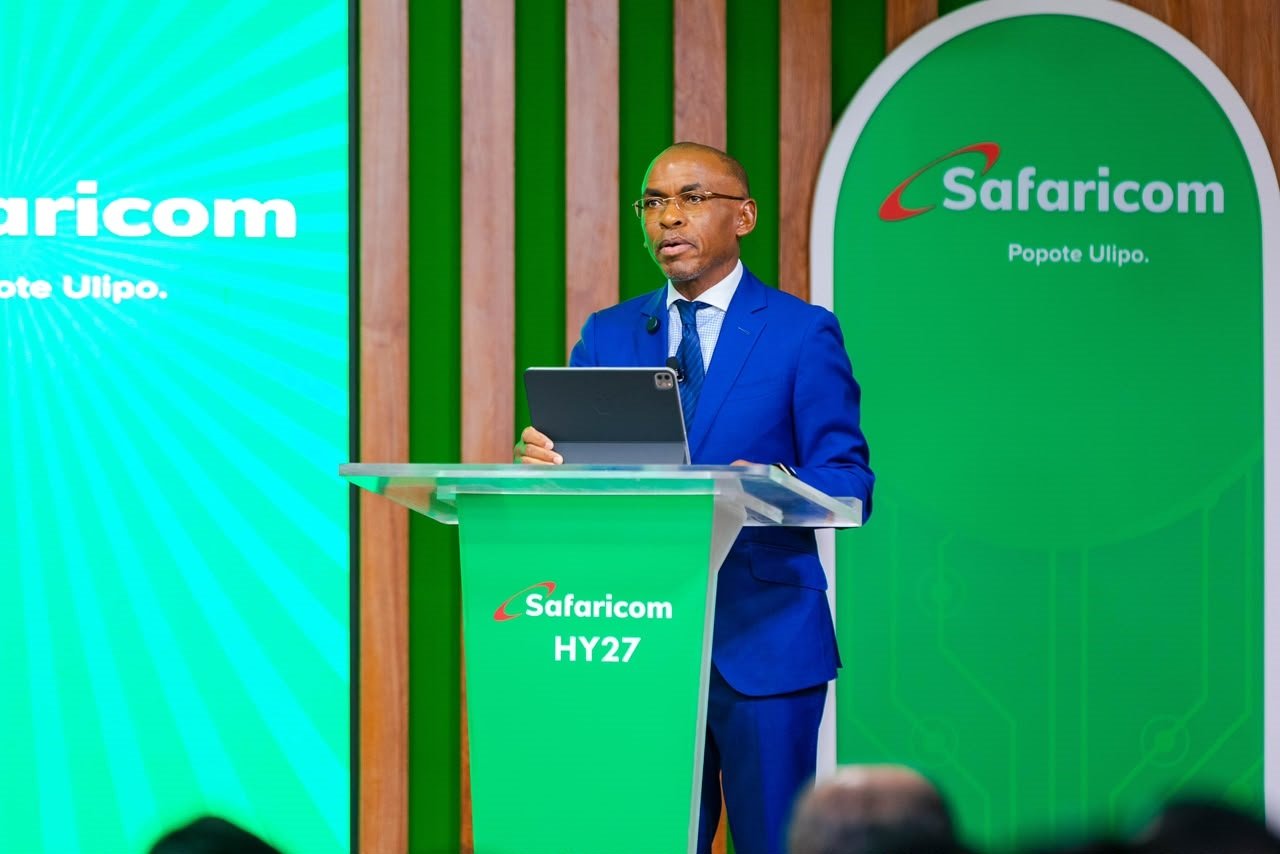
- Kenyan telco’s half-year earnings beat on M-PESA and data growth, while its costly Ethiopian venture moves within sight of operating break-even.
- Group service revenue rose 13.1% to KES 226.1 billion, but Kenya remains the engine of profitability and Ethiopia the source of both the drag and the upside.
Safaricom reported a 35.9 per cent rise in net income excluding minority interest to KES 58.15 billion for the six months to 30th September, as strong growth in Kenyan mobile money and data revenue combined with a dramatic narrowing of losses at its Ethiopian subsidiary.
The results, announced on Thursday, compares with KES 42.78 billion in the same period a year earlier. Earnings per share rose to KES 1.45 from KES 1.07.
The headline number was flattered by an accounting effect at group level: profit attributable to equity holders of the parent rose even as total group profit after tax, which includes losses borne by minority partners in Ethiopia, climbed 72.5 per cent to KES 50.35 billion.
Safaricom Ethiopia’s losses shrink
The single largest swing factor was Safaricom Telecommunications Ethiopia, where earnings before interest, tax, depreciation and amortisation improved from a loss of KES 12.56bn to a loss of just KES 434.4 million, a 96.5 per cent reduction.
Ethiopian service revenue grew 71.6 per cent to KES 10.62 billion, driven by mobile data, which rose 90.2 per cent to KES 7.85 billion and now accounts for 74 per cent of the unit’s service revenue. One-month active customers grew 43.4 per cent to 12.2 million, and average data consumption per subscriber rose 14.8 per cent to 7.72GB.
The improvement in EBITDA was also helped by a sharp fall in net foreign exchange losses within other operating expenses, from KES 9.39 billion to KES 1.07 billion, reflecting a more stable birr, which depreciated 4.3 per cent against the dollar in the period to 163.39.
Group CEO Peter Ndegwa said stronger customer demand, increased network utilisation and improving operational execution were “translating into better operating leverage and reinforcing our confidence in the long-term opportunity.”
The Ethiopian business remains lossmaking below the EBITDA line: depreciation and amortisation of KES 10.92 billion and net finance costs of KES 4.92 billion pushed it to an operating loss of KES 11.35 billion and a post-tax loss of KES 16.6 billion. But the trajectory is now the central question for investors.
Read also: Safaricom posts 52.1% jump in half-year net earnings to $331M, Ethiopia loss narrows
Kenya market delivers the cash
Safaricom’s Kenyan business remains the group’s profit engine. Safaricom Kenya’s net income rose 13.8 per cent to KES 66.27 billion, comfortably covering the Ethiopian loss at group level.
Kenyan service revenue grew 11.3 per cent to KES 215.96 billion. M-PESA revenue rose 13.6 per cent to KES 100.07 billion, contributing 54.7 per cent of the growth, while connectivity revenue grew 7.7 per cent to KES 103.38 billion and fixed service and IoT revenue rose 25.5 per cent to KES 12.51 billion.
Within M-PESA, the merchant ecosystem expanded rapidly: the merchant base grew 90.3 per cent to 4.51 million, Pochi customers rose 115.3 per cent to 3.23 million, and wealth management assets under management jumped 69.7 per cent to KES 25.56 billion. Chargeable transactions per one-month active customer rose 31.5 per cent to 50.89.
Mobile data revenue in Kenya grew 12.2 per cent to KES 45.24 billion, with 4G+ devices up 33.5 per cent to 34.3 million and average usage per chargeable subscriber up 9.4 per cent to 5.31GB. Voice revenue grew 6.2 per cent to KES 42.20 billion.
Kenyan EBITDA rose 13.3 per cent to KES 128.94 billion, and operating free cash flow climbed 19.6 per cent to KES 85.31 billion.

Group margins expand
At group level, service revenue rose 13.1 per cent to KES 226.06 billion, and total revenue 14.2 per cent to KES 233.68 billion. EBITDA grew 27.5 per cent to KES 129.18 billion, lifting the margin from 49.5 per cent to 55.3 per cent. EBIT rose 39.8 per cent to KES 91.14 billion.
The margin expansion owes much to Ethiopia: group other operating expenses fell 11.1 per cent to KES 44.54 billion, largely because of the smaller foreign exchange losses in the Ethiopian unit. Excluding the currency effect, cost growth was more modest.
Group net finance costs were broadly flat at KES 9.91 billion, while the tax charge rose 18.9 per cent to KES 30.98 billion.
On a constant-currency basis, the group said service revenue grew 13.6 per cent, EBIT 33.6 per cent and net income excluding minority interest 30.0 per cent, a reminder that reported growth is partly a function of exchange-rate translation, with the birr conversion rate moving from 0.9553 to 0.8088 to the shilling.
Read also: Safaricom’s Green Bond: Fueling M-Pesa’s Sustainability Goals
Cash generation and a new spectrum licence
Net cash generated from operating activities rose to KES 91.92 billion from KES 64.74 billion. Capital expenditure on property and equipment was KES 40.27 billion, down slightly, while acquisition of intangible assets rose to KES 14.51 billion.
That increase reflects a 25-year spectrum licence renewal granted by the Kenyan government effective 1 July 2026, recognised as an intangible asset at the present value of contractual cash flows. Group net debt widened to KES 193.39 billion from KES 139.81 billion at the March year-end, reflecting the new licence obligation and higher borrowings.
The company paid dividends of KES 45.56 billion during the period, versus KES 26.33 billion a year earlier.
CEO Ndegwa said the second half would focus on “protecting and growing connectivity and payments, scaling merchant and financial-services propositions, accelerating fixed and enterprise technology solutions and maintaining execution discipline in Ethiopia.”
The central issue for the market is whether Ethiopia can complete its journey to EBITDA break-even and then to profitability. Management cautioned that the pace “will continue to depend partly on pricing implementation, foreign exchange conditions and disciplined execution.”
The balance sheet also carries the unresolved Vodacom–Government of Kenya transaction, announced in December 2025, under which Vodacom agreed to increase its effective interest in Safaricom by 20 per cent. The company pointed shareholders to Vodacom’s most recent regulatory update on the deal.
(1USD=KES130)

Leave a Reply