
- Mauritius has been selected to host COP13 of the Nairobi Convention in 2028.
- The country calls for stronger collective action among island nations to address the growing impacts of climate change through access to predictable and accessible climate finance, and turn climate commitments into concrete action and results.
- Zanzibar’s temporary fishing closures model to be adopted regionally.
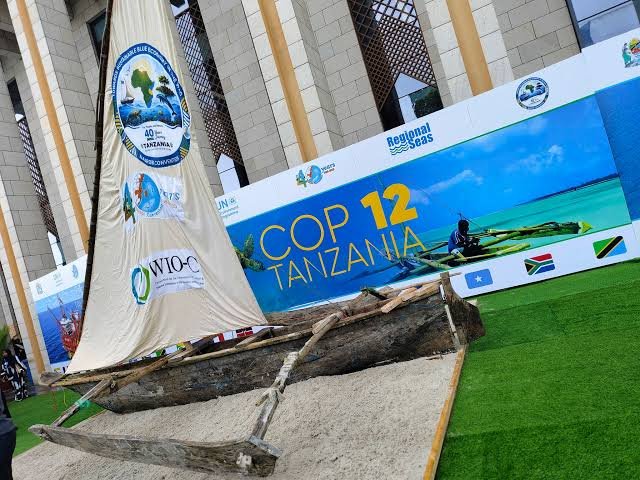
Tanzania hosted the 12th Conference of the Parties to the Nairobi Convention (COP12) where delegates assessed implementation progress of the resolutions adopted at previous meetings and passed 15 key decisions focused on ocean governance, marine and coastal biodiversity, reducing plastic pollution, and climate resilience across the Western Indian Ocean (WIO) region.
Speaking to the press this week, Secretary General of Zanzibar’s Ministry of Education and Vocational Training, Khamis Abdulla Said said, among other things, the conference established new strategies meant to strengthen conservation of marine and coastal environments in the Western Indian Ocean region.
The meeting, which was held at the Julius Nyerere International Convention Centre (JNICC) in the commercial port city of Dar es Salaam, coincided with celebrations to mark the 40th anniversary of the Nairobi Convention.
The Tanzanian delegates called on the COP12 members to take stronger action to safeguard marine ecosystems. “The fact that Tanzania is hosting COP12 reflects the country’s growing role in international diplomacy,” the Secretary General commented.
The Secretary General said Tanzania’s marine, forest and broader environmental resources place the country at the center of regional and global discussions on sustainable conservation. “The conference is expected to produce new resolutions that will address current environmental conservation challenges,” he added.
The diplomat stressed the importance of protecting marine ecosystems as a vital economic resource necessary for the well-being of both marine life and humans, since we all rely on each other, he emphasized.
Seconding the view, Minister of State in the Vice-President’s Office (Union and Environment), Engineer Hamad Masauni, also called on the Nairobi Convention member states to take stronger and coordinated action against climate change.
He underscored worsening marine pollution and decried unsustainable use of ocean resources which he warned are threatening marine ecosystems and coastal livelihoods in general. He went on to remind the delegates that decisions reached at COP12 should be based on scientific evidence and translated into national and regional policies that take into account coastal communities, women and youth.
The Secretary General recalled that Tanzania had, during its chairmanship of the Nairobi Convention, spearheaded several initiatives including completion of protocols on marine and coastal biodiversity and protected areas, a Regional Oil Spill Emergency Plan and a Regional Strategy on Plastics and Associated Chemicals.
According to the government official, Tanzania has begun developing a regional vision and implementation framework for marine biodiversity in areas beyond national jurisdiction which will be presented for adoption.
Also Read: Kenya, Tanzania and Congo corridors to drive East Africa trade growth by 2035
Tanzania COP12: The 15 key resolutions
The Dar es Salaam conclusion of COP12 adopted 15 key resolutions structured across four strategic areas to protect, manage, and sustainably develop the Western Indian Ocean (WIO) region.
Delegates resolved that Mauritius will be the next host country for COP13. To help tackle marine pollution and waste management, there would be a regional plastic strategy that helps address plastics and associated hazardous chemicals to curb land-based and marine pollution.
Along with the strategy for plastics, they also adopted an Emergency Response Contingency Plan; a binding regional contingency protocol that forces all the member countries to collectively prepare for and rapidly respond to major transboundary oil spills and toxic chemical leaks.
They also agreed to implement tighter restrictions for and monitoring of industrial runoff and agricultural wastewater flowing into coastal zones under what was termed as the Land-Based Pollution Control protocol.
Secondly, they agreed on the Ecosystem Restoration and Biodiversity Protection under which they developed the Critical Habitat Protection mandate. The document calls for strict restoration of vital marine ecosystems, specifically focusing on mangroves, seagrasses, and coral reefs to bolster climate resilience.
Then there is the Fisheries and Conservation Synchrony that covers localized initiatives like Zanzibar’s temporary fishing closures, that was used as a good example to be adopted into the regional framework as a method to allow depleted fish stocks to recover.
The delegates went on to pass what they christened ‘Community-Led Rewards’ a protocol that endorses community-based financing models that reroute coastal tourism revenue directly to local populations actively managing conservation areas.
When it came to Ocean Governance and Strategic Financing, COP 12 agreed on Cross-Border Cooperation. This protocol formally recognized the WIO as “one connected system,” and by so doing, legally expanded framework capabilities to manage ecosystems that cross national boundaries.
COP 12 also established the formation of a centralized fund to provide stable, long-term financing for transboundary environmental projects that was dubbed, ‘Regional Conservation Trust Fund.’
Another agreement was for Marine Spatial Planning (MSP). COP 12 agreed to “scale up standardized national frameworks for zoning ocean waters, balancing industrial transport and commercial fishing with heavily protected ecological zones,” reads the media communique released after the conference.

Leave a Reply