
Several commentators have already written the eulogy of mainstream television, especially Pay TV, claiming it is only a matter of when, not if, before they get wiped off the entertainment scene by streaming services, but as FRANK KISAKYE writes, Pay TV if anything, is only increasing investments and attracting new investors.
If the French entertainment giant Canal Plus’ (Canal+) January 2024 offer and South Africa’s MultiChoice Group’s rejection of the nearly $3 billion buyout proposition for the remaining shares that Canal+ doesn’t already own tell you about the promising future of pay TV, then you need to think again.
Canal+ would not offer that much if they saw no future, and MultiChoice would not reject if they were indeed worried about their prospects.
Why is Canal+, which has since increased its stake in MultiChoice to 35.01%, so interested in buying out MultiChoice that they have now sought the help of Africa’s first black billionaire, Patrice Motsepe (also president of the Confederation of African Football) to help seal the deal, yet we have been severally told that online streams are soon replacing terrestrial television and satellite television?
On the subscribers’ side, however, the now perennial subscription increments (March for StarTimes and April for MultiChoice) are unjustified, more so for “repeated” and “old” content. But what justifies these increments? The Observer explores.
TAXES
An innocent question many high school students interested in journalism often ask is, how do radios and television stations make money? To them, the TVs and radio stations broadcast to their sets or phones (for Gen Zs) for free, anyway.
With the emergence of pay TV, the question is almost almost self-explanatory now, but it still lingers. Unbeknownst to them is that even for free-to-air (FTA) television, before the content gets to their sets, an avalanche of taxes has to be paid, never mind the daily operational costs. Officially, the regulator, Uganda Communications Commission (UCC) categorises the TVs under FTA, pay TV and hybrid (those that broadcast on both).
Regardless of category, all of them pay an application fee of $2,500 (about Shs 9.5 million). For regional broadcast, the station must pay an initial entry of $5,400 (about Shs 20 million) and then annual fees of $2,700 (about Shs 10 million).
All these fees are exclusive of VAT and the trading license, which vary according to location and company portfolio. Expectedly, the fees are higher for pay TV.
The license application fee is the same at $2,500. Thereafter, the station must pay $27,000 (Shs 103 million) as the initial entry fee and then the annual fee of $20,300 (Shs 77 million). Beyond those fees, as The Observer discovered, for FTA, broadcasters pay Shs 6.6 million annually for mast space (although Multichoice has its own mast which is an even higher cost).
Additionally, there is also Shs 12 million charged monthly by Signet (UBC signal distribution arm, which was born following the digital migration in 2015 when UCC switched off all analogue television signals.)
The Media Council of Uganda, which classifies content (age suitability and ratings), charges 250,000 for every 12 minutes reviewed. This means a one-hour movie/programme is charged at least Shs 1.4 million. The Uganda Performing Right Society (UPRS) which claims to administer copyright in music on behalf of both local and international musicians, also charges broadcasters Shs 2 million annually.
LOCAL CONTENT
Lately, local content is all the rage and the two pay TV market leaders, MultiChoice and StarTimes have gone into developing and promoting of local content, with MultiChoice clearly in the lead here.
The investments are intentional, according to StarTimes vice president, Aldrine Nsubuga Snr. The investment of $500,000 per year in general entertainment in the three local TV stations, Makula Kika, Sanyuka Prime and Makula that run locally procured content has begun to bear fruit.
He says two years since Makula channel was launched, it is their most viewed channel on StarTimes’ 80 channel catalogue, which he says is an endorsement and appreciation for local content.
For the Uganda Premier League, Nsubuga says, they have invested over $7m in securing the broadcast rights for 10 years and the Shs 4 billion per year towards production and broadcast of 150 live games is money that goes directly to Fufa TV and Next Media, the two companies in charge of production.
“For us, this is indicative of what the audience wants and we have to invest more. Everyone thought people had lost interest in local content, but the audience has reversed the trend and we have to listen to the audience,” he said.
But no player has possibly invested in local content as much as MultiChoice Africa, and their legacy and success stories are implanted forever on the continent’s film industry through their MultiChoice Talent Factory (MTF) launched in 2019.
The MTF-accredited regional academies in Nairobi, Kenya serving East Africa, Lagos, Nigeria (West Africa), Lusaka, Zambia (Southern Africa) offer hands-on 12-month experience and theory training to 60-74 emerging talents every year from across 14 countries on the continent in cinematography, editing, audio production and storytelling, among other film disciplines.
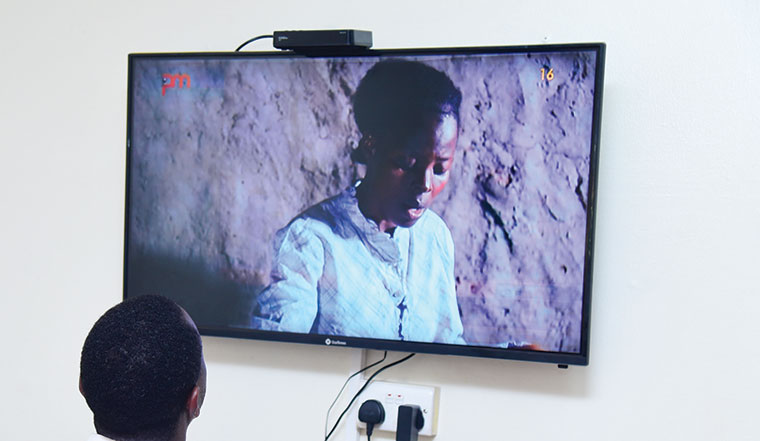
They are trained by experts from established global brands such as Dolby Laboratories, Zee World, New York Film Academy, and FOX Portugal. Rinaldi Jamugisa, MultiChoice public relations and communications manager, said on the three MultiChoice local content channels, Prime Magic (PM), Prime Magic Plus (PMP) and Prime Magic Loko (PML), they have over 20 commissioned and licensed shows showcasing a diverse range of talent from the Ugandan creative community.
He says in the last three or four years, the success of those local content channels has been due to MultiChoice Uganda’s strategic investments and a deep understanding of the Ugandan entertainment landscape.
“We have invested in local content productions, nurtured our local talents through skills training and production support and mentorship, creating a strong connection with the Ugandan filmmakers, creating a ripple value effect on our very diverse audience.”


Jamugisa adds that MultiChoice has also tried to be as inclusive as possible in regard to local content with shows like Junior Drama Club (JDC), now in its second season, resonating well with younger audiences. Damalie, Mizigo Express, Prestige and Sanyu are more cherished for their relatability in many Ugandan homes, while the recently concluded season of Kampala Crème appealed more to the elites.
When prompted, StarTimes and MultiChoice were uncomfortable revealing how much they pay for the local shows, but according to The Observer findings, StarTimes pays producers about Shs 2.5 million per episode while DStv’s pay is dependent on one’s production costs since the pay tv buys the concept rather than already produced material.
One producer said: “MultiChoice should know that they don’t pay us enough, but at least they are better than StarTimes. We invite these guys to come to our productions and see that they don’t pay us enough, only that we love what we do.”
Both Jamugisa and Nsubuga say the justification for the subscription price increment is that content is expensive. Could it be why cheaper initiatives such as Kwese TV and GTV failed to take off, despite the pomp and promise they held?
Also, StarTimes and MultiChoice argue that they invest a bulk of their earnings back into Uganda through talent development. Ugandan actors and producers are now enjoying better pay for their craft, high-quality productions and sets, as well as advanced film technology, all of which Jamugisa said MultiChoice is directly involved in.
Jamugisa said, for example, four Ugandan MTF alumni from the class of 2020 (Abubaker Isiko, Victoria Nakimbowa, Daisy Masembe and Pius Talemwa) began a production house, Gogolo Films in 2021.
“Aaron Tamale from the first cohort (2018/19) now works as a First AD in Zebra Productions in Nairobi, Kenya” he said.
Zebra Productions is producing the adaptation of the South African drama series, Gomora. Ivan Tusabe from the class of 2022 is part of the production crew for DStv- commissioned film under Maisha Magic Movies titled, Ego Check.
Isiko has gone on to win awards including one for the best post-production/editing for the film, The Passenger at the recently ended Uganda Film Festival. Presently, he contributes his expertise in sound design to one of DStv’s shows, Sanyu.
On the other hand, Victoria Nakimbowa has been a scriptwriter for the concluded Prestige series and set designer for the ongoing Beloved series on Pearl Magic Prime. She has also won awards, while Cissy Nalumansi has gone on to win several awards and produce feature films.
In terms of production, productions like Sanyu (Matthew Nabwiso), Prestige (Nathaniel Magoola), Juniors Drama Club (Allan Manzi), DamaLie (Doreen Mirembe), Date My Family (Judithiana Namazzi) have been recognized by UCC and other film awards.
PIRACY
The Observer’s questions to UCC regarding copyright and piracy were unanswered by press time, but a UCC official who did not want to be quoted, previously told The Observer that as a regulator, they found pay TV stations in Uganda ‘exploitative’ and although they were aware of several piracy equipment in the country especially those broadcasting via Internet Protocol television IPTV, they are tempted to let subscribers choose what is best and cheaper for them.
Indeed, these pirated services are cheaper but unreliable, since without any known physical presence in the country, they can circumvent licenses and taxes and also don’t invest anything in terms of content production but rather pick on what others have already invested in.
John Vianney Nsimbe, who has worked for several TV productions, says from the production perspective, the subscription prices for pay TV are fully justified. He says even MultiChoice’s premium package of Shs 290,000 is justified because that would be less than Shs 10,000 per day.
“For the content offered throughout the day, is that content really worth that price? I have been with DStv and have seen the investment they put into their productions and when you see what they invest in and what they charge, it’s all justified. For example for CECAFA games that I worked on in Tanzania, we would be in the stadium doing pre-productions with the entire crew as early as 9am for games meant to start at 4pm. We would go through lineups, player stats, research and there would be 30 to 40 crew and over 10 high-end cameras for just one game. Their OB van was like a [small apartment]!” Nsimbe said.
Pirated services remain cheaper, but they invest zero in terms of infrastructure, content creation or content buying; not so for Pay TV; so, it could be a while before you see a cut in subscription fees.
fkisakye@observer.ug
Source: The Observer
Share this content: