
In a fieldwork trip in Europe sometime back, I learned that in Germany — not sure if it applies to all the states of Germany — any member of the public is free to walk into any seminar or lecture room and attend any courses or seminars of their choice.
They do not have to be students or fellow academics. But ordinary folks. (And I do not mean public lectures, but student seminars/ classes).
Let me paint this picture more vividly: a random boda boda rider, streetworker from Katanga, a carpenter at Ku-bbiri, or a vendor from Wandegeya market is legally free to walk into Lecture Room 4 during a class on ‘Literary stylistics’ and sit in, and listen.
On their part, the professor is obligated to entertain this stranger without any qualms, even if they look unprepared for the course. They will even raise their hands to ask questions.
The idea behind this provision— which is the founding spirit of all universities—was that a university, in the universal sense of the term, would be a ‘space of empowerment’ to all members of society, some in a more specialised way, coming as students, and others in a more open, general way, as members of the general public.
Notice also that in Germany, education is a public good—part of the taxpayers’ bill—and learners only pay functional fees. Thus, when a stranger walks into your seminar or lecture room, they are not interested in acquiring a degree, but just satisfying their curiosity or an immediate knowledge gap.
Thus, learning itself was freed from the incumbrances of pre-documentation, pre-qualification and tuition. It is the exclusionary/classicist nature of British and French colonialism, exacerbated by capitalism, that eroded this sense of education as a public good.
In our westernised world nowadays, learning became closely tied to money/tuition, and thus permanently reproducing a class system where those who can afford tuition end up more educated, informed, and more resourced and thus highly placed in society. Repeating the cycle.
Those whose parents cannot afford private property, have no access to education, are permanently excluded, and exploited.
Indeed, from sensibility—of freeing learning itself—universities got directly fused with the general public. So, many universities across the world constitute entire villages and towns. While the university could have an iconic building or a square, they were never enclosed/walled in establishments.
Thus, within this university town (Oxford, Cambridge, Makerere, Al-Azhar, Columbia), members of the general public engaged in the other activities and actually competed for space with the more specialised members of that community, the students and faculty.
At the end of the day, the main beneficiary were the students: the university relied on the occupations, confusion and strangeness of members of the general public to bring their students up to speed to the world they lived in. University learning was not just in class, but in the university town, which included both peers and strangers, bullies and gentlemen. It was a small replica of the world.
Back to Germany, of course, not many people exploit the provision that allows strangers to attend classes of their choosing. Except in times of agitation, say when activists intend to crowd out an unwanted academic.
But generally, teaching and administering courses have become more technocratized (course outlines accessed through specific portals), and more and more walls around seminar rooms make random access difficult. But also, the hustles of work-life have made these provisions appear redundant. But the spirit is real and immensely core to university life.
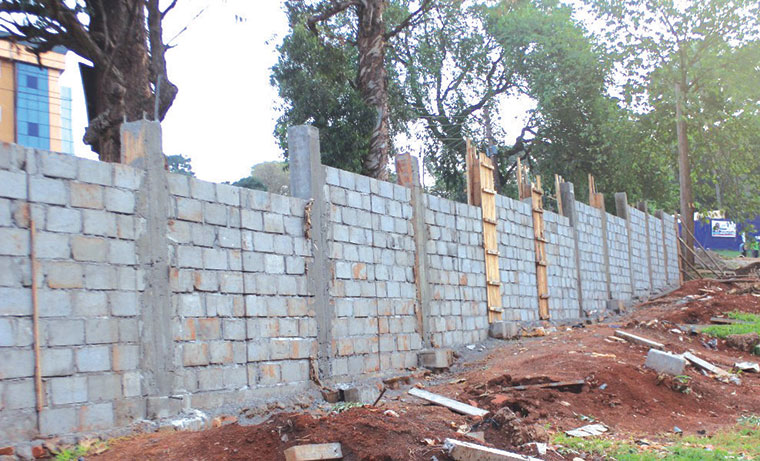
BEHIND MAKERERE WALL
The now glittering wall enclosing Makerere, which has taken years of building, masks a threefold crisis: (a) the corrosive epidemic of land theft, which is finishing off the country, (b) a national condition of controlling dissent by all means necessary, and (c) both the arrogance and cowardice of Makerere University academics considering themselves not just as better than their compatriots but also seeing themselves as occupying a different space — and thus requiring a high-rise wall to make that distinction.
The most enthusiastic advocates of the wall argue that the rate at which their vehicles — mostly their Japanese-made thirdhand cars — were being vandalised was too high. That there were too many idlers and vagabonds roaming “their premises” and thus needed to be locked out.
But what type of fictional world would this be where a university trains brittle and pampered graduates for a world filled with criminals and vagabonds!? It doesn’t make sense.
Or consider that seemingly more mature contention that ‘outsiders’ entering and working in ‘their’ university inflicted a cost on ‘their’ (public) infrastructures. What is this? Like these were two countries? Consider the admins of Gulu town arguing that visitors inflict a cost on their public infrastructure!
There is more confusion: The founders of Makerere University imagined a village with some subtle markers of difference (such as a hedge), but with easier fusion with the general public.
This is why across Hajji Musa Kasule road is the University hospital (Ham Towers is seated on stolen university land, as Mayor Erias Lukwago has endlessly reminded us), and the Makerere University Flats stand beside the university hospital.
Across Bombo road is all Makerere University land, going all the way to include Mulago hospital, which is part of the university. The university has property and teaching facilities in the Kololo area, and all these lie outside of this new grand enclosure.
What then is being enclosed? In truth, at the risk of losing more land to ‘developers’ pushing from Wandegeya area, Makerere Kavule and Sir Apollo Kaggwa, building a wall became something urgent with successive regimes.
A NAWANGWE–MUSEVENI AFFAIR
University students have been central in collapsing autocracies across the world. Young (which also means, with no property), exuberant and reeling in Karl Marx’s and Frantz Fanonian declarations on violence, revolution, taking back the land, and enlightening the masses, modern autocrats are ever weary of students.
With the Arab uprisings over a decade ago, autocracies in Black Africa have been working their heads off to detect the cracks in their safety net. Where would a more lethal protest come from?
The location of Makerere University, which is about 4km from State House Nakasero, makes it a centre of serious interest for Uganda’s Museveni.
How does one make sure students at Makerere are under tight control in the sense that if anything breaks out, they cannot easily mix with their more disgruntled neighbours in downtown Kampala, but also, have it difficult to escape once cornered by the security forces?
The wall becomes an even more brilliant idea. With the almost successful dismantling of Kisekka market, containment was the option for Makerere University.
Over the years, Bwana Museveni has struggled with controlling dissent around Makerere university. He not only sought to infiltrate students’ religious organisations, centres of cultural expression (such as the now obliterated Nkoba za Mbogo), but also almost successfully has the Makerere University staff trade union on its knees.
To successfully accomplish this, he forged alliances with celebrity academic, Prof Mahmood Mamdani (who once labelled MUASA executives, ‘regime change intellectuals’), and then found use-value in Prof Barnabas Nawangwe – co-opting him into the NRM intellectual wing.
The speed at which Prof Nawangwe signs letters expelling dissenting academics and students is mindboggling. With funds from the Consolidated fund, the enclosure is running at a supersonic speed. Soon, only ID-carrying members will be allowed into Makerere University gates, and visitors will have to carry extensive documentation to be allowed in.
Look, Makerere University has always had some form of wall around it, a see-through wall in most parts. But this new wall is ominous, an embodiment of the anti-university ethos. In truth, under a different regime of political order, we will have to break it down.
yusufkajura@gmail.com
The author is a political theorist based at Makerere University
Source: The Observer
Share this content: