
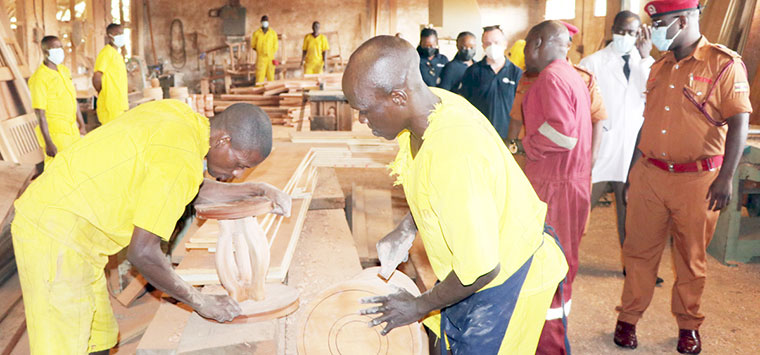
The Uganda Prisons Service is looking for Shs 19 billion to build low-cost prisons in Mbarara, Arua, Tororo and Gulu, according to the officials who appeared before parliament last week.
A prison, high-end or low-cost, is where they keep people who are either accused or convicted of committing crimes, the majority of whom are young people for the case of Uganda.
If you are attacked by thieves in Kampala or any urban area, you will realize the crime is committed by largely young people who have either failed to find jobs or simply want a good life, easily.
You see, there is an increased glorification of wealth. Some people appear on the scene without any known legal source of income and start throwing around money, driving fancy cars and being guarded by members of the elite “sharp shooters” squad.
Media houses even interview them or make them panelists on all sorts of things, giving them platforms to facilitate them to commit more crimes. Young people watching such interviews get their brains ingrained with the belief that wealth can easily be got. Politicians, poor only the other day, splash opulence in the face of their voters as soon as they are elected (or appointed) to office.
Then the Uganda National Examinations Board (Uneb) released the results of the Primary Leaving Examinations (PLE) indicating that nearly 900,000 children sat for the exams. Yet approximately 400,000 students are able to sit for their Senior Four examinations or what is known as the Uganda Certificate of Education (UCE).
Where do the 500,000 pupils that sit for PLE go since they don’t sit for UCE? Some join some technical schools but I believe many are the reasons why the prisons officials were in parliament looking for money for low-cost prisons in each major region of the country.
But a week before the prison officials appeared in parliament, some politicians from Masaka were elated, posting on their WhatsApp statuses of the major achievement of building a “Shs 2.8 billion modern mortuary in the city.” This is when one should use the exclamation; Kabaka Mwanga! Why would anyone be happy that a multibillion mortuary has been built, especially in a country that lacks basic healthcare facilities?
Young people (largely) are either ending up in low-cost prisons or in high-end morgues. Yet that shouldn’t be the case. None of them wants to end up in either of them. They want opportunities.
They want to earn but many aren’t guided properly. Many inspired by their opulent leaders or those presented as wealth simply go for the same life. Like primary education, secondary education too is free in public schools.
If we don’t want our children to end up in prison or the mortuary, we need to push them into secondary education and then make it relevant for them so that they can find jobs they need after UCE. Secondary education is the highest level of education most Africans will ever attain; so, it is crucial that it is relevant and addresses the challenges of our time.
Usually, children in primary schools, at least some of them, are taken to some factories where bread, soda and sugar, among others, are processed. Schools call them learning trips. Others go to the airport and zoo. Some clever school administrators even take them to dingy shopping malls around Kampala, at a fee!
But can’t we also include low-cost prisons and mortuary while emphasizing that if they don’t continue with their education, there is a likely chance that they will end up in such places when they are still so young? A campaign like that could put some of them in line.
Before you say that this would create fear in the eyes of children, we had similar campaigns with so much success. Do you remember the HIV/Aids campaigns of the 1990s? Seeing the state in which famous singer Philly Lutaaya was in opened many people’s eyes and partly saved a generation.
Seriously though, we can track every child that joined Primary One and didn’t finish Primary Seven through their schools and enroll them into skilling programs that can enable them to find some decent jobs.
We don’t even need to wait for P7; schools know which children have abandoned school as the majority live in the same communities, and then give them some skills that are applicable in their areas of residence so that they don’t end up in crowded low-cost prisons and some fancy place only when they are dead.
djjuuko@gmail.com
The writer is a communication and visibility consultant
Source: The Observer
Share this content: