
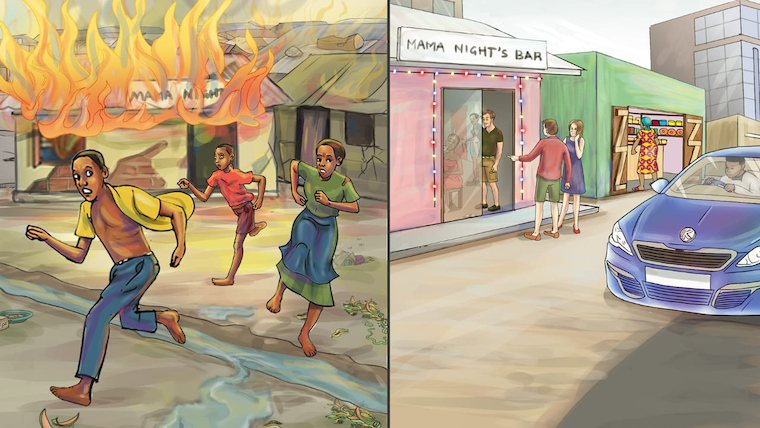
I will tell one more Mama Night story and stop. Let me jump to my recent visit of this place we once called home. I am hopeful in future, I will return and tell the many stories in-between.
But I have to say, the slum was an inexhaustible pool of escapades and wonderous encounters — and, of course, lifelong lessons, and imagery. And I am not saying we need more slums). I recently visited the place which was once our beloved Mafubira Zone B, and only confirmed the stories I had heard — and the hallucinations we had after a wildfire gutted the entire slum or a huge part of it.
The place had gentrified or was gentrifying with street names in English, and plot numbers. Yes, all former residents knew something more was going on when it got burned down. The story goes that Mama Night refused to go down alone. Her boys — I was not one of them — burned down the entire place, leaving behind vacant attractive tracks.
After about two years of a police ribbon — of the entire slum — by the time the iron sheets and “Crime Scene” ribbon came down, strangers from Kampala and beyond had erected, not mansions or bungalows, but more non-slummy houses. There were white people among them. (I will never understand the guiltlessness of Mzungu buying land from a recently burned down slum—which hitherto was residence to the wretched of the earth).
Dear reader, you could not believe my shock that, after over 20 years, Mama Night actually recognised me when I visited recently. She did not die as the story had been told in the midst of the fire pandemonium. She is alive and well, and now one of the dignified and sophisticated ladies of the suburb.
“Are you not the ka-Serunkuma who used to have a big stomach?!” she asked amidst sly smiles. I almost shot back that as she recalled my big front, that I also recall her terribly sinful behind. I didn’t say that, but smiled and reminded myself about how much I loved sugarcanes. I could eat three or four long ones in one single sitting, and then run to the football pitch, shirtless! I was a good goalkeeper. To quote, the famous nostalgic lines of Mary Hopkin, “Those were the days, my friends… we thought they would never end.”
Returning from Mafubira — the now unrecognisable slum — going down memory lane as you have read from Mama Night’s bar in the past weeks, and reflecting on my present world as an adult, I still find it amazing how governments easily convince the poor that their poverty is a product of their own doing; own failing.
The poor are told — and are so persuasively made to believe — that they could be rich if they were not lazy, lacking in work acumen, or just unlucky. And to remedy, especially their bad luck, they are told, prayer does the magic. So, you will find strings of makeshift churches at every corner of the slum. (Yes, while Muslims, too, believe in the absolute goodness of prayer, and we tend to be very prayerful folks, there is normally just one mosque).
The point I am making here is that morality, ethics, and decorum tend to be vigorously emphasised in ghettos as gateways to a good life! (Yeah, most kids from Kololo and Ntinda don’t understand the goodness of prayer, except as performative discourses of their parents’ loot).
And this being the case, our slum in Mafubira was a religious, morally-driven space. And thus, for any residents who fell out of this order of morality and religiosity, they would be seriously stigmatised. Recall that difficult, nervous meeting where a maid who worked at Mama Night’s bar announced that Mama Night had kept a secret “school roster” of all her leg clients; you would have heard a pin drop upon that girl’s thoughtless utterings.
Although she didn’t say her boss was threatening to make it public, the threat was unmissable. Over half of the men present at that Resistance Council (RC) meeting — arguably serious men of the slum — all drank at Mama Night’s bar. It was our Kampala Club. The silence lasted about a minute, before one woman saved the day, sending a direct threat to Mama Night.
Yes, it was a woman, something that surprised many, and emboldened the men in turn.
“Let her release that roster,” Mama Sam started, “we’ll kill her,” she threatened. “We have always suspected her bewitching our men into sleeping with them, and once we have that list, all of us the wives of this slum will burn down her bar. Is it even a bar? It is just a sorcerer’s shrine!” she concluded to some faint applause.
It was a sigh of relief. You could see smiles returning to the faces of the men, as a member of the womenfolk handed the guilty ones the coolest of exit windows. Yes, witchcraft is as widespread in the slums just as religion.
THE MAN FROM ZAIRE
No one ever imagined that the threat of the secret ‘school roster’ would be good for business. Days after the unintended threats, Mama Night’s bar received a spike in clients. Old and new clients seemed to have rediscovered their taste for “Kill Me Quick” and thronged her place to quench their thirst (or was it not anxiety over the secret school roster?).
We had been dismissed from school over non-payment of school fees, and I was often inside Mama Night’s bar entertaining her customers. This was the beginning of structural adjustment and my father who worked as a factory worker in Jinja had lost his job a year earlier, and had started struggling with school fees.
I have to tell you, dear reader, Mama Night’s bar had never been this full as it became after the threat, and the drinkers ever this nice to Mama Night, her maids and the dancing boys. They tipped with wanton abandon. But you could not miss the anxiety and unease on the faces of these drinkers. Many would be caught stealthily scanning the alehouse for any traces of a book, a roster.
Anything that looked like scribbling. They wanted to steal it. Even Mama Night’s schedule during the day became busier with clients competing for space and attention. Many came with basketfuls of bread and Blue Band margarine. Others brought her fish, and Cowboy cooking oil. If niceness would kill, it would have killed this woman.
When these day clients entreated her bar these days, it seemed no one wanted leg, but just to drink and be nice to her. It was the ‘school roster’ on their mind. In the days that followed, Mama Night’s rumoured ‘school roster’ of leg clients made her the most powerful, most hated, but also most graciously treated woman in the slum.
When structural adjustment hit my father hardest, we left Mafubira to the villages of Mukono. We learned of the fire that gutted the slum from a neighbour who visited us in Mukono a year after we had left. There was no Mafubira Zone B slum anymore. The story goes that to get the prized school roster, a group of men figured it out that getting the famed charcoal burner back into the game would do the magic.
It turns out the charcoal burner was not actually a charcoal burner, but a Lingala artiste from Zaire, who had only overstayed in Uganda. He did some charcoal business as a side hustle. The charcoal burner was commissioned to befriended Mama Night, and one day, the prized black book went missing. Again, it was Mama Night’s thoughtless maid who confirmed the theft of it, loud night cheers in the slum.
That night, Mama Night herself started a fight at her alehouse, and it is rumoured that either herself or one of the angry drunkards decided to set the place on fire. Could also have been the work of the slum wives who hated her witchcraft over their husbands.
yusufkajura@gmail.com
The author is a political theorist based at Makerere University.
Source: The Observer
Share this content: