
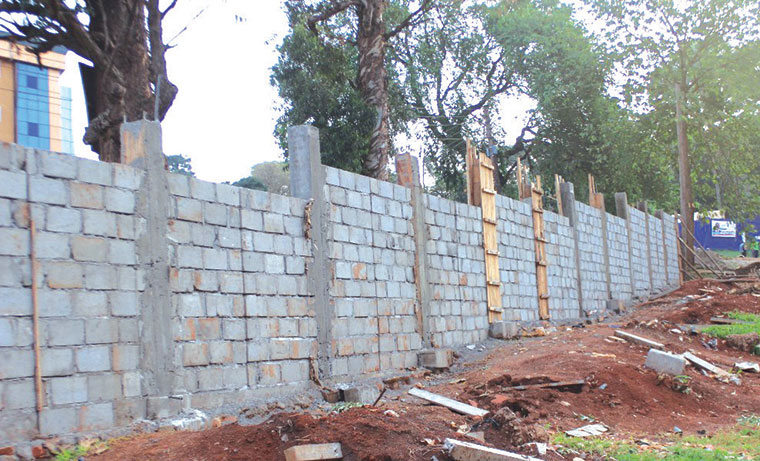
After the publication of my piece critical of the wall enclosing Makerere University (Under a different regime, we’ll knock down the great Makerere University Wall), I received plenty of responses — some hostile, as expected, and others intellectually-engaging, still as expected.
My hostile interlocutors challenged my position in the university, wondering whether I actually finished my PhD, considering that my criticism risked my completion possibilities. (Maybe this is a cowardly and not a hostile position, in the spirit of the wall).
Others, the crudest of them, sought to actually sabotage my position in the university, and, as I write, I know folks actively cooking up mischief against my position in Makerere. Consider this, immediately after the piece came out, the banner announcing my book on Covid-19, Non-Essential Humans that, for months, uninterruptedly advertised my book at the main gate, planted on the small entrance into my department, MISR, was angrily removed by a Makerere University security official. (You would think Makerere would be proudly associated with the intellectual work of their own).
But Makerere University academics and overzealous administrators need to be reminded that that hill—in its over 100 years of existence—has seen men and women with stellar talents, who also wielded immense power. But all had to exit at
some point—and some have been terribly forgotten like they never existed!
Our legacies ought to matter, and as the Eritreans say, “better to die like a lion, than live like a dog.” What will mourners say at your funeral? That he made so much money whilst living like a hound, or that you died trying to make their world a better place.
Or they will mourn and say your poodle- like strategies that were meant to keep alive and survive could not protect you from a corrupt bus-driver who crashed you in your small Japanese-made thirdhand Toyota car! Or that it is the medics at Mulago who failed you when they went on strike and your oxygen cylinder emptied and you ran out of breath!
Dear colleagues at Makerere, as night follows day, glowing fire soon turns into cold impotent ash, and indeed, “amalusu gafuuka engeregeze.” But while hostility towards my writing at Makerere University should be seen as entirely embarrassing, it ought to be understood as part of that problematic script of control and containment that has taken hold in the last 5-10 years – more concrete under the Prof Barnabas Nawangwe reign.
Many wonderful scholars have been coerced into silence (even on things where the learning and guidance would have been absolutely necessary). This ought to be understandable, and we should not begrudge them because this risk is real. But as noted above, you could be run over by a bus, or go out as a victim of a medical strike.
ENTER COMRADE BROTHER EDWIN KARUGIRE
The publication of my piece—critical of the wall—coincided with news of the newly constituted university Appointments Board, which is now headed by Edwin Karugire, a son-in-law of the first family. Despite his good breeding and education, no one knows precisely the value that this beautiful brother brings to Makerere University as chair of the Appointments Board.
Despite being a renowned lawyer in town, his ‘intellectual productivity,’ which would be argued as his connection to ‘a university’—and thus chair its appointment board—is not known. But since we are selecting from our extended first family, wouldn’t brother Odrek Rwabwogo be more suited (recall that wandering column that went with the name, ‘Ideology’ in
The New Vision; it was something).
Or the writer, my former friend, Natasha Museveni Karugire who has three titles with Fountain Publishers. In truth though, Karugire or Rwabwogo or Natasha, their appointment can only be read as an extension of the university wall—ensuring that only humble academics and students circulate in this once prestigious university that has now become a fetish of power and politics for Museveni’s reign.
DEBATING THE WALL
But the hostility above notwithstanding, I also received some really intellectually- engaging responses that have forced me to return and re-explain and emphasise some position of mine on this wall.
The most engaging of these comments came from my wonderful friends, Dr Aisha Nakiwala, and my co-editor of our book on oil, Before the First Drop, Dr Eria Serwajja, both of whom find some of my arguments, problematic Among other things, both contend that universities across the world practice an exclusionary education system with high walls and extra locking codes for lecture venues and Makerere should not be seen as different.
In all fairness, this is fair criticism and I acknowledge these points in my earlier piece. But my contention that the spirit of the ORIGINAL university—which was actually a Muslim University, and was like a Darus (a learning session) in the mosque— learning was fused with the general life of the society.
Learners benefited (learned from, and matured from) closely interacting with and watching the active life, the confusion, strangeness, and general disorder that the general public wrecked onto the university. Because that is the world first-hand—and graduates were not estranged upon graduation.
Second, universities with the high walls, wherever they exist, are not the best in the world. The so-called ivy leagues universities in the western and Muslim world (from Al-Azhar, UDSM to Oxford and Harvard) are university villages or towns with departments and students mingling with the rest of the village.
Dr Nakiwala was optimistic that despite the high wall, the university is gradually returning to the original order, with more boda-bodas and more petty businesses operating inside this wall. I am only sceptical. Very sceptical about Dr Nakiwala’s optimism, and I think later on—and I am happy to be proved wrong—it will be an absolute requirement for people coming to university to present proper identification, be able to speak English, and many will be turned away.
That we make visitors with vehicles to pay entrance or parking fees is anti- university in itself. That we kicked out taxis and boda-boda in the spirit of order is not just arrogant, but bereft of actual conceptualisation of a university.
No wonder, the quality and creative potential of our graduates is declining every passing year. Whatever the case though, our Ivory Tower will need to be re-imagined under a different regime of politics.
yusufkajura@gmail.com
The author is a political theorist based at Makerere University
Source: The Observer
Share this content: