
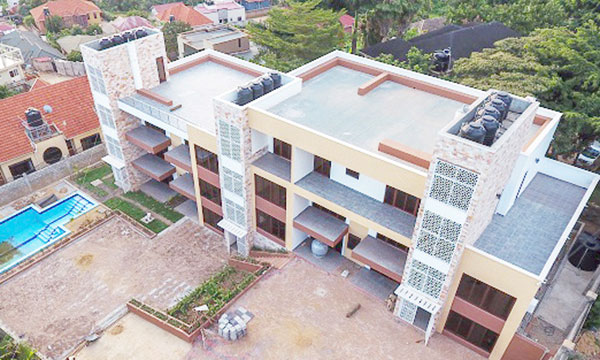
President Museveni recently noted that the most revenue leakages are in form of rental income and corporate tax from telecommunication companies. His sentiments were hinged on the fact that incomes from rental premises are grossly undertaxed even when real estate is one of the fastest growing industries in Uganda.
From ignorance about tax compliance obligations among real estate owners, to poor urban planning and limited statistical data on the number of rental houses in the country, the reasons the revenue leakages are many.
Amidst pressure from the president, Uganda Revenue Authority (URA) has made several attempts at ensuring that it maximizes revenue collections from rental income since voluntary compliance has been futile.
This has been through numerous amendments in the law relating to taxation of rental income over the years. In some of the amendments, tax payers with rental incomes have been accorded unprecedented tax incentives to lure them into declaring their rental income but this did not yield positive results.
Instead, it has led to uncertainty in the industry about taxation of rental income in Uganda. Certainty is one of the cardinal principles of taxation as postulated by Adam Smith and Joseph Stieglitz.
It demands that tax payers are clearly informed about why and how taxes are levied. In 2017, for example, Parliament introduced estimates of rental income to be applied by URA to assess tax payers that fail to file returns or whose returns did not reflect the accurate amounts of rental tax due.
The regulations made under this amendment provided an amount of income that was deemed to be obtained by landlords with rental premises by looking at the proximity to road facilities, location, and proximity to other amenities.
As such, a landlord with a three bedroomed house in Kololo was estimated to be collecting Shs 1m while a landlord with a similar house in Kyaliwajjala was estimated to be earning Shs 300,000. It was to this amount that a rate of tax was imposed.
Effective July 1, 2018, the law was amended to allow individuals claim a deduction on interest paid on a bank mortgage obtained to set up rental property.
Subsequent years came with several other amendments. The most notable was the 2021-2022 financial year amendment in which a tax payer was allowed to deduct 75 per cent as an allowance for costs, on top of deducting the interest paid on a mortgage incurred to obtain the rental property.
For these expenses and costs to be allowed as deductions, a tax payer was expected to provide evidence verified by URA.
This evidence included supporting agreements, rental receipts issued to the tenants during the year among others. A taxpayer was also expected to declare all sources of rental income and promptly furnish tax returns within the year of income.
Much as allowing a deduction of 75 per cent was a generous incentive intended to lure tax payers into disclosing their actual rental income, revenue leakages persisted as several tax payers remained adamant and did not disclose their actual rental income.
URA embarked on other modes of ensuring that rental tax leakages are clogged like enhancing the tax informer award policy and the introduction of an American technology (RippleNami) to develop a Rental Tax Compliance System that enables government to integrate data to match real estate properties to their individual or corporate owners.
This technology is expected to divulge information across providers of amenities like National Water and Sewerage Corporation (NWSC), Umeme and others in order to establish the number of occupants in a building and establishing the location of such buildings.
For instance, where data indicates that a high number of electricity and water units are used by occupants of a certain building, this data will be integrated with the location of the building and an inspection carried out to determine whether the building is occupied by tenants or not.
At the introduction of the RippleNami, it was estimated that URA would obtain a ballpark figure of roughly $200m as rental income tax, over and above the approximately $30m that is currently collected annually by URA.
As of now, there is no available data to indicate the results of RippleNami much as it has already indicated success in disclosing a huge number of uncompliant landlords.
However, for URA to register more effective results, it has to liaise with financial institutions to obtain more data on recipients of rental income. The Landlord and Tenant’s Act of 2022 made it mandatory for landlords to provide identification to tenants on top of opening bank accounts for the purpose of receiving rent and providing receipts for all the rent paid.
On top of the results obtained from using RippleNami, the enactment of the Landlord and Tenants Act can also be used by URA to obtain information pertaining to how much rental income a landlord obtains in a period of a year. This will effectively stabilize the rental tax regime and ensure compliance hence reducing revenue leakages.
nahumuzad55@gmail.com
The writer is an advocate of the High court and a tax expert
{loadpositon inarticle}
Source: The Observer
Share this content: