
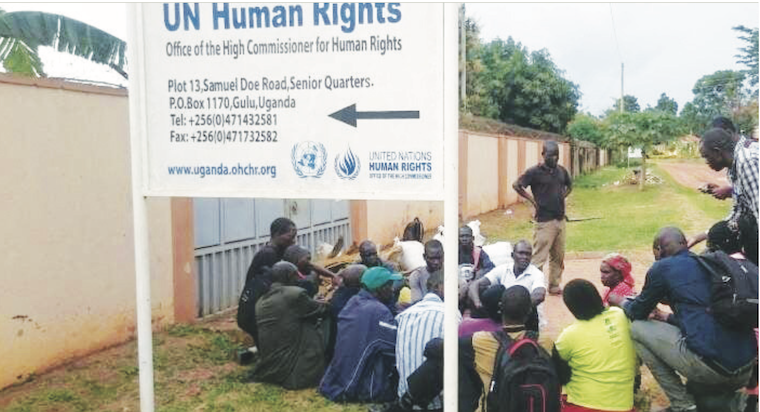
Last week, this column engaged with the troubling opinion expressed by the Chairperson of the Uganda Human Rights Commission, to the effect that human rights in Uganda needed to be ‘depoliticized’.
In explaining why this view is distinctly problematic we noted, among other things, the power asymmetry between individuals and the state. Human rights are, therefore, important normative tools, allowing citizens some measure of protection against the tyranny of unchecked state power. We noted that this was the philosophical basis for the design of Article 20 of the 1995 Constitution.
In the present column, we seek to tell another part of the thinking behind Article 20, in light of historical and contemporary challenges to human rights. It will be recalled that Article 20 (2) provides that ‘[t]he rights and freedoms of the individual and groups enshrined in this chapter shall be respected, upheld and promoted by all organs and agencies of Government and by all persons.’
The four words at the end of that provision – ‘and by all persons’ – introduce a powerful new dimension to the protection of human rights in Uganda; that is to say, the recognition that human rights are in danger from, and must be protected from violation by, persons: natural and corporate.
This is a particularly important framing because while the state remains extremely powerful at the international, regional and national planes, corporations – particularly large multinational corporations (MNCs) – have long emerged as alternative sites of power. Indeed, MNCs can be as powerful as, if not more than, certain states.
In economic terms, some of the world’s largest corporations have market values which are significantly higher than the GDPs of many countries. To take but one example, while Uganda’s GDP hovers in the range of USD 116.2 billion (see Heritage’s 2023 Index), the 2023 edition of Forbes’ ‘The Global 2000’ estimates TotalEnergies at USD 151.6 billion, Shell at USD 205.45 billion, Amazon at USD 1,084 billion, Microsoft at USD 2,309 billion and Apple at USD 2,746.2 billion.
On this basis alone, if – as we argued last week – human rights are a response to the potential abuse of power, then we have much to fear from the operation of such mega corporations. This situation has been compounded by the rise of companies – so-called private military companies (PMCs), but really mercenaries – founded with the main objective of putting military resources at the disposal of the highest bidder.
One only has to look at the record of the infamous ‘Executive Outcomes’, and more recent outfits such as the Wagner group, to appreciate the danger posed by these actors. Indeed, all that stands between certain corporations and the violation of state sovereignty – and human rights – is a very thin and ever fraying international legal order.
The power of corporations is, therefore, one which Ugandan civil society should be keenly aware of, as a starting point for devising effective responses the new threats this power poses to human rights and freedoms. A major challenge they might find in this regard is that some of the development partners who support democracy and human rights work in Uganda may be unwilling to support any meaningful work in this critical area.
To give but one completely random example, the French embassy might hardly be expected to support scrutiny into the activities of TotalEnergies Uganda. So, for this important work to be done, it must be done in non-traditional ways, and with unusual courage – in full knowledge of, and preparation for, non-traditional challenges and pushback.
Many large corporations, being better resourced than many governments, will be willing and able to retain some of the best and brightest Ugandan legal minds and pay them well enough to utilize, and weaponize, our laws (including the 1995 Constitution) to meet their objectives.
An interesting instance in this regard is provided by the litigation in British American Tobacco Ltd v Attorney General and Another (Constitutional Petition No.46 of 2016). It was, interestingly, a constitutional petition, brought to challenge aspects of the Tobacco Control Act of 2015.
The company contended that the Act violated a range of constitutional rights, including the rights to carry on a lawful occupation, trade or business (Article 40(2)); speech and expression (Article 29(1)(a)); freedom from discrimination (Article 21 (2)); property (Article 26); and fair hearing (Article 28 (1)).
The power dynamics in this case were only balanced by the intervention of a non-governmental organization – the Centre for Health, Human Rights and Development (CEHURD) – which applied to be added as a respondent, and supported the Attorney General in effectively defending the critical public interest concerns at stake.
The Constitutional Court (composed of Justices Alfonse Owiny-Dollo, Kenneth Kakuru, Frederick Egonda-Ntende, Hellen Obura and Ezekiel Muhanguzi) also rose to this occasion, recognizing the trojan-horse character of the petition. In rejecting the petition, Justice Kenneth Kakuru observed as follows on behalf of a unanimous court:
‘This petition, I have no doubt in my mind, is part of a global strategy by the petitioner and others engaged in the same or related trade to undermine legislation in order to expand the boundaries of their trade and increase their profits irrespective of the adverse health risks their products pose to the human population … the petitioner admits that its products when used in accordance with their instructions result into serious adverse health effects to their users and others. They also concede that the products they manufacture and sale cause death.
Legislation such as the [Act] that seeks to protect the public from the adverse effects of the petitioner’s products cannot be said to be unconstitutional … The Constitution firmly protects the rights of its citizens.’ This attempt by BAT Uganda was a classic example of what we referred to in our column of 16th August this year – referencing Professor Philip Alston’s 2002 article ‘Resisting the merger and acquisition of human rights by trade law’ – in terms of the danger of appropriation of human rights language by commercial actors.
Luckily for Ugandans, the Constitutional Court was alive to this danger, and rose up to the occasion. It is, of course, also true that corporate power is not wholly, or even primarily, malevolent. Companies do many good things. Indeed, their services are important for the enjoyment of many human rights.
MTN, Airtel, and others, for instance, are central to our enjoyment of the freedoms of speech, expression and association. Private hospitals similarly support the rights to health and life, while private schools promote the realization of the right to education.
Nonetheless, with great power comes great responsibility – and the possibility of great abuse. The Ugandan government has itself experienced the reality of this power, with Facebook effectively adjudicating upon the actions of some of its officials in the context of the 2021 elections and choosing to ban them from that platform.
In retaliation, our government continues to ban Facebook in Uganda – in the process frustrating the efforts of a number of small businesses who were barely earning a living by marketing their services through that medium (bakers, tailors, florists, farmers, carpenters and many others).
Relatedly, the well- documented activities of Cambridge Analytica, which had a corrosive effect on the Kenyan elections of 2017, continue to serve as a stark reminder of the significant danger companies pose even to the most fundamental rights of self-determination and democratic governance.
That said, the biggest danger to human rights comes when these two huge violators of human rights – governments and corporations – come together to squeeze the ordinary person. A good example in this regard is presented by the recently launched ‘Intelligent Transport Monitoring System’ (ITMS), recently launched by the Uganda government.
Essentially, the government is partnering with a shadowy Russian company – ‘Joint Stock Company Global Security’ – to install surveillance chips in every number plate – with the result that the State and the corporation will have the capacity to know where each car owner is, almost to the very second.
Evidently, our phone calls are no longer private. Now, we shall each be required to pay for, and install, a device on our vehicles for the purpose of tracking our every movement. We are squarely in the dystopian world envisaged in George Orwell’s book – ‘1984’.
Unfortunately, thus far, – in the face of one of the greatest threats to our collective civil liberties – Ugandan courts have proven either unwilling or unable to rise up to the occasion and protect us from this grave intrusion.
It is important that we push back against State abuse of power. However, it is equally important for Ugandans to recognize the significant power wielded by companies, and the danger this power poses for the enjoyment of our constitutional rights and freedoms.
When these two sites of authority, the state and the corporation, coincide to further erode our inherent liberties – as in the case of the ITMS – we should collectively resist this, or collectively suffer even further indignities. In the immortal words of John Donne: ‘…send not to know for whom the bell tolls, it tolls for thee.’
The writer is senior lecturer and acting director of the Human Rights and Peace Centre (HURIPEC) at the School of Law, Makerere University, where he teaches Constitutional Law and Legal Philosophy.
Source: The Observer
Share this content: